
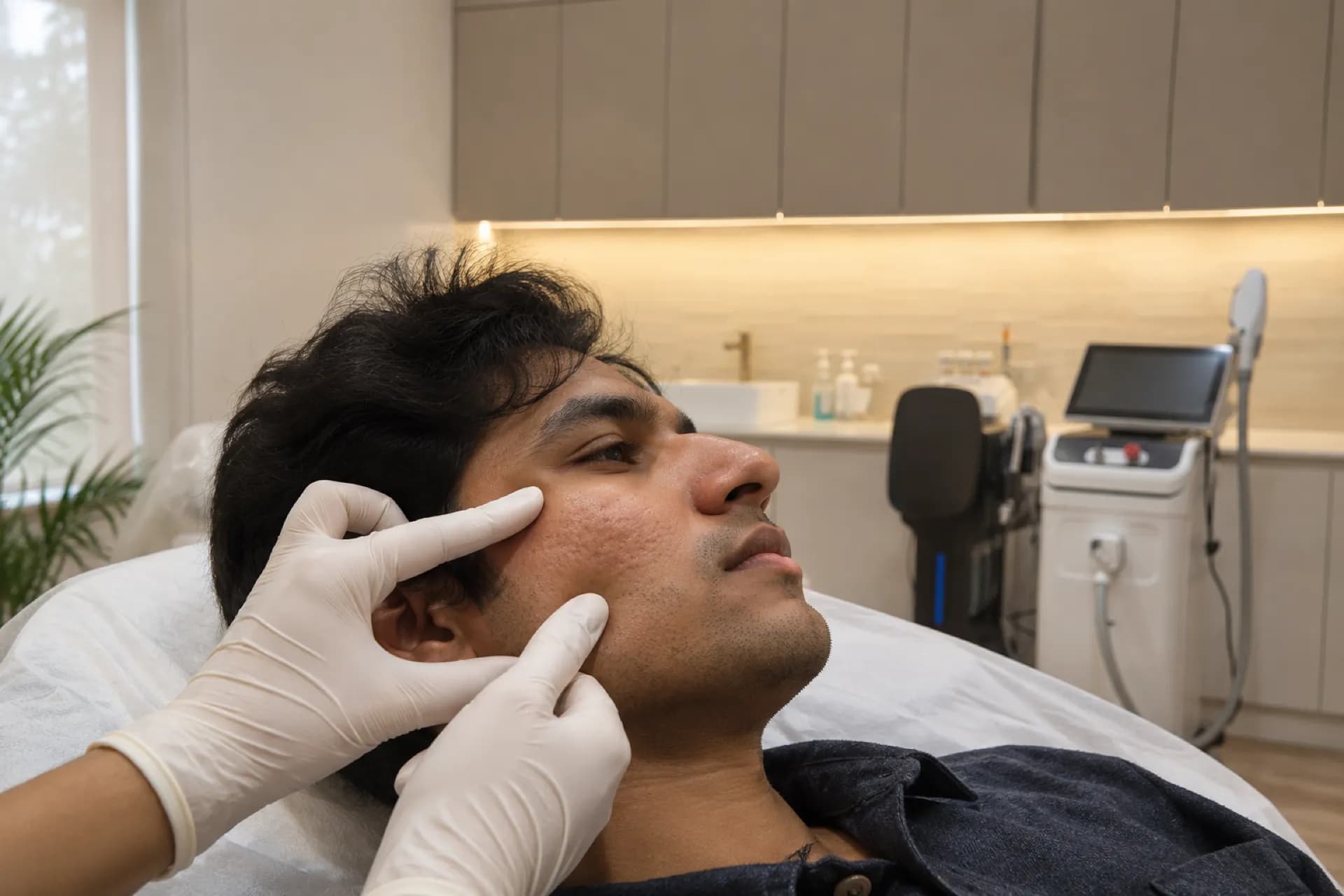
Pimple scar treatment, matched to scar type.
Acne scars come in different shapes, and each responds to different approaches. We identify the type, settle any active acne first, then plan a staged course for your skin. Scars can look better. They do not disappear.
Two taps, then WhatsApp. A doctor reviews your history before any treatment is suggested.
4.9 from 1,238 Google reviews(Delhi centre)Doctor-led since 2004
Acne Scar Treatment at a glance
- Indicative price
- ₹5,500–₹15,000 per session
- Sessions
- Several, in a staged course
- Interval
- Usually weeks apart
- Downtime
- Varies by method
- When to judge results
- Over months, not days
- Starts after
- Active acne is controlled
What these figures mean
- Indicative price
- Delhi NCR range; it depends on the method and the area treated.
- Sessions
- The number depends on scar type, depth and method. Your doctor sets it.
- Interval
- Skin needs time to heal and rebuild between sessions.
- Downtime
- Redness was the most common effect in a 2025 review of radiofrequency microneedling.
- When to judge results
- Studies follow people for 1 to 6 months after the last session.
- Starts after
- Scar treatment during active breakouts is usually deferred.
Indicative range in Delhi NCR. Your doctor confirms the plan and final price at consultation.Updated
The short answer
Pimple scars are treated according to their shape: rolling, boxcar or ice-pick dips, plus any dark marks left behind. Research shows several approaches can improve how scars look, but none removes them and no single approach has been shown to be clearly better. A doctor identifies your scar types, settles any active acne first, then plans a staged course for your skin.
Is pimple scar treatment right for you?
Often suits
- People whose acne has settled, or is controlled with treatment, and who are left with dips or uneven texture.
- People with more than one scar type on the same face, who need a plan that combines approaches.
- Adults who accept gradual, partial improvement across several sessions and months.
- People who want an honest assessment of what is realistic before any procedure is booked.
May not suit
- Active, inflamed breakouts that are not yet controlled. These are treated first.
- Flat brown or red marks with no dip in the skin. These are pigment or redness, not scars, and are treated differently.
- Pregnancy or breastfeeding, when most in-clinic scar procedures are deferred.
4 more reasons
- Anyone taking or recently stopped isotretinoin, until the doctor who prescribed it has been asked about timing.
- Skin with an active infection, a cold sore or open wound in the area.
- A tendency to keloid or raised scars, which needs a doctor's assessment before any procedure.
- Anyone expecting scars to disappear completely.
Acne scar laser treatment and other options, by scar type
An acne scar forms when a deep, inflamed pimple damages the dermis, the collagen layer under the surface. The skin repairs itself with new collagen, but the repair is imperfect. In the most common type, atrophic scars, tissue is lost and the surface dips. Ice-pick scars are narrow and deeper than they are wide. Boxcar scars are broader, with sharp edges and a flat base. Rolling scars are shallow and wavy, often because bands of fibrous tissue tether the skin down. Different shapes respond to different approaches. Techniques that stimulate collagen, such as microneedling or radiofrequency microneedling, are often considered for broad shallow scars. Subcision releases tethering bands under rolling scars. Narrow ice-pick scars are usually treated with a focused approach, such as spot chemical resurfacing or laser. Dark or red marks after acne are a separate issue from scar texture, and a plan treats them separately. Most faces carry a mix of types, so plans are often combined and staged.
- Epidermis, the surface
- Dermis, where collagen sits
- Fat layer below
- Fibrous bands
Rolling scars
Wide, shallow dips with soft sloping edges. Fibrous bands under the skin can tether it down, so the surface looks wavy.
Often considered
- Subcision, releases the tethering bands
- Microneedling or radiofrequency microneedling, builds collagen across the area
- Fractional laser, may be added to smooth the surface texture
Boxcar scars
Round or oval depressions with a flat base and sharply defined, vertical edges. Shallow ones sit in the upper dermis.
Often considered
- Fractional laser or chemical peels, resurface shallow scars
- Microneedling, alone or in combination
- Subcision, may be added for deeper, wider scars
Ice-pick scars
Narrow and V-shaped, deeper than they are wide, reaching into the deeper dermis. The most common atrophic type.
Often considered
- Focused chemical resurfacing, such as TCA CROSS, applied scar by scar
- Focused laser, aimed at the scar itself
- Microneedling or radiofrequency microneedling, to smooth the skin around the scar
Most faces carry more than one type, so plans often combine approaches. In a Cochrane review of 24 trials, no single approach was shown to be clearly better than the others.
General guidance, not advice for your skin: your doctor decides after examining it. Sources: DermNet NZ; Cochrane review of acne scar interventions; ASAP 2024 Indian consensus on acne scar management.
How care runs at Clinic Eximus
The same order for everyone, so nothing is decided before the cause is clear.
Step 1
Consultation and scar mapping
Your doctor examines your skin under angled light to identify rolling, boxcar and ice-pick scars, how deep they are, and any pigment or redness. They ask about your acne history, current medicines including isotretinoin, pregnancy plans, cold sores, keloid tendency and sun exposure.
Step 2
Active acne first
If breakouts are still active, they are treated and controlled before scar work begins. Daily sunscreen starts now, because Indian skin is more prone to dark marks after procedures.
Step 3
A written, staged plan
Approaches are matched to each scar type, with the number of sessions, the per-session price range and the review points set out in writing before you commit.
Step 4
Sessions, spaced weeks apart
Treatment is staged so the skin can heal between sessions. Your doctor explains aftercare and what redness or downtime to expect for your method.
Step 5
Review against your photographs
Progress is judged over months against your starting photographs. The plan is changed or stopped if it is not helping.
What the research says
Published studies and guidelines, linked so you can read them yourself. Evidence is not a promise for any one person.
24 trials. A Cochrane review of 24 trials found injectable fillers gave better scar improvement than placebo at 24 weeks (moderate-certainty evidence). For lasers, peels, needling and radiofrequency the evidence was very low certainty, and no approach could be called clearly better than another. (From the Cochrane Library: Interventions for acne scars (review CD011946; PMC10334917), 2022) opens in a new tab
36 studies. A systematic review of 36 studies of non-energy techniques reported improvement of 31% to 62% for microneedling and 10% to 100% for subcision, and some people saw no benefit. Studies were small, used different scoring methods and had little long-term follow-up. (A systematic review of treatments for acne scarring, part 1: non-energy-based techniques (PMC5965325), 2017) opens in a new tab
16 studies · 481 people. In 16 studies (481 people) of radiofrequency microneedling on its own, improvement was reported across scar types, with follow-up mostly 1 to 6 months. Temporary redness was the most common effect. Post-inflammatory hyperpigmentation was reported in several studies, mostly in skin types III to V, and was generally temporary. (Fractional radiofrequency microneedling as a monotherapy in acne scar management: systematic review (PMC11706011), 2025) opens in a new tab
3 more studies
Skin of colour. A 2023 review of lasers for acne scars in skin of colour concluded that lasers can significantly improve how scars look, but no laser removes them completely. People with skin of colour are at higher risk of post-inflammatory hyperpigmentation, so protocols should suit both scar type and skin type, and risks should be explained first. (Havelin and Seukeran, Laser treatment of acne scarring in skin of colour, Clinical and Experimental Dermatology (PubMed 36763696), 2023) opens in a new tab
India consensus · 2024. A 2024 consensus of dermatologists and plastic surgeons, meeting in Mumbai, Delhi, Bengaluru and Kolkata, found no single guideline for atrophic acne scars. Their practical approach: treat active acne early, then tailor a combination plan to scar type, with realistic expectations on results and downtime. (Practical aspects of acne scar management: ASAP 2024 consensus, meetings in Mumbai, Delhi, Bengaluru and Kolkata (PMC11003649), 2024) opens in a new tab
32 papers · 1,485 procedures. A systematic review of 32 publications (1,485 procedures) found too little evidence to support a blanket delay for most procedures in people on or recently off isotretinoin. It advised against mechanical dermabrasion and fully ablative laser, and advised an individual risk discussion with the prescribing doctor. (Isotretinoin and timing of procedural interventions: systematic review with consensus recommendations, JAMA Dermatology, 2017) opens in a new tab
We will tell you if acne scar treatment is not the right first step for you.
Your first six months
Typical milestones from published studies and guidelines. Your doctor sets your own schedule.
Week 0
Consultation, scar mapping and starting photographs
Before sessions
Active acne settled first, if there is any
Months 1–3
Staged sessions, with healing time between them
Month 3
First review against your starting photographs
Month 6
Judge the change, then continue, pause or stop

What to expect
- Treatment can improve how scars look. It does not erase them back to smooth, unmarked skin.
- Change builds gradually. Studies follow people for months after the last session, so judge results over months, not after one visit.
- Response varies by scar type, depth and skin. The evidence does not show any single approach to be clearly better, and some people see little change from a given method.
- Different scar types on one face usually need different approaches in the same plan.
- Dark or red marks after acne often fade over months on their own, and are managed separately from scar texture.
Side effects and safety
- Indian skin (Fitzpatrick types III to V) is more prone to post-inflammatory hyperpigmentation after lasers, peels and needling. Reviews describe it as generally temporary, but it can last for months. Your doctor adjusts the method and preparation, and daily sunscreen matters before and after.
- Redness, swelling, tenderness and pinpoint bleeding are common for a few days after needling or resurfacing.
- Less common effects include infection, a cold sore flare in people prone to them, and further scarring. Tell your doctor if you get cold sores.
- Tell your doctor if you take, or recently stopped, isotretinoin. Ask the doctor who prescribed it about timing, and do not stop or restart any medicine on your own.
- People who tend to form keloid or raised scars need assessment first, because procedures can trigger them.
- Tell your doctor if you are pregnant or breastfeeding. Many procedures are deferred, and a doctor decides.
- Contact the clinic if you notice spreading redness, pus, fever or pain that is getting worse.
Acne scar treatment cost in Delhi
₹5,500–₹15,000
per session
Indicative range in Delhi NCR. Your doctor confirms the plan and final price at consultation.
What changes the cost
- Scar type and depth: deeper or more varied scars usually need more sessions.
- The area treated, and how many scars there are.
- The method or combination of methods in your plan.
- How many sessions are in your starting course.
- Skin preparation and aftercare products, including sunscreen.
- Treating active acne first, which is a separate cost.
Questions people ask
Can pimple scars be removed completely?
No approach removes acne scars completely. A 2023 review of lasers in skin of colour concluded that lasers can significantly improve how scars look, but none eliminates them. The aim is a smoother surface and softer edges, built up across several sessions. Your doctor will tell you plainly what improvement is realistic for your scar types before you start, and judge progress against your own photographs.
Which treatment works for which type of pimple scar?
Doctors often consider microneedling or radiofrequency microneedling for broad, shallow scars, subcision for rolling scars tethered by fibrous bands, and focused resurfacing for narrow ice-pick scars. Most faces carry a mix, so plans are usually combined. Evidence does not show any one approach to be clearly better, so your doctor matches the plan to your scars and your skin.
How much does pimple scar treatment cost in Delhi?
Across Delhi NCR, acne scar treatment usually costs about ₹5,500 to ₹15,000 per session. Your total depends on scar type and depth, the area treated, the method or combination, and how many sessions are in your course. Your doctor confirms the plan and the final price in writing at consultation, before you commit to anything.
How many sessions of acne scar treatment will I need?
Most scar plans are staged over several sessions spaced weeks apart, then reviewed. The number depends on how deep your scars are, which types you have and the method chosen, and no single figure applies to everyone. Studies mostly judge results one to six months after the last session. Your doctor sets the number after examining your skin and revisits it at each review.
Is acne scar treatment safe for Indian skin?
It can be, with the right method and preparation. Indian skin (Fitzpatrick types III to V) is more prone to post-inflammatory hyperpigmentation after lasers, peels and needling. Reviews describe it as usually temporary, but it can last months. Your doctor tailors the method and settings to your skin, and daily sunscreen before and after treatment is part of the plan.
Can I treat acne scars while I still have pimples?
Usually not. Dermatology guidance is to treat active acne first, because new breakouts keep adding scars and inflamed skin heals less predictably. Your doctor will usually settle the breakouts with medical treatment, then plan scar work once the skin is calm. Treating acne early also lowers the chance of new scars forming.
Do I need to wait after isotretinoin before scar treatment?
Ask the doctor who prescribed it. The old rule of waiting six months has been questioned: a 2017 systematic review found too little evidence for a blanket delay for most procedures, but advised against mechanical dermabrasion and fully ablative laser, and advised an individual discussion. Do not stop or restart isotretinoin on your own to fit a procedure.
Will pimple scars go away on their own?
Dark or red marks left by pimples often fade over months. Dips in the skin do not. The American Academy of Dermatology notes that acne scars can fade over time but rarely disappear completely without treatment. If a mark is flat and the skin surface is smooth, it is probably pigment, not a scar, and is managed differently.
Can I treat acne scars at home or naturally?
Home care can protect skin and help dark marks fade, mainly through daily sunscreen and not picking. Creams and home remedies do not fill or lift a dip in the skin, which is where procedures come in. Harsh DIY remedies can irritate skin and leave new dark marks in Indian skin, so check with a doctor before trying them.
Read next
Article
Pimple Treatment: Options, What Works, and When to See a Doctor
What helps active acne, what does not, which medicines are a doctor's decision and how to avoid scars. For marks and dips that remain, see acne scar treatment.
Article
Dark Spots on Face: Causes, Types and What Helps
How to tell sun spots, marks left by acne and melasma apart, why depth in the skin matters, and what a doctor may suggest.
Article
Hydrafacial Benefits and Disadvantages: What the Evidence Shows
What a Hydrafacial can and cannot do, how strong the evidence is, the side effects to expect and who should be cautious or wait.

Find out which scars you have first.
A doctor looks at your skin and what is behind the concern, then writes a plan with the full price before you begin.
Choose skin care, a centre and a time
Two taps. Nothing is stored on the website.
Your message opens in WhatsApp
You send it yourself and can add anything for the doctor.
The team confirms your visit
Your doctor reviews your history before suggesting anything.
4.9 from 1,238 Google reviews(Delhi centre)Doctor-led since 2004