
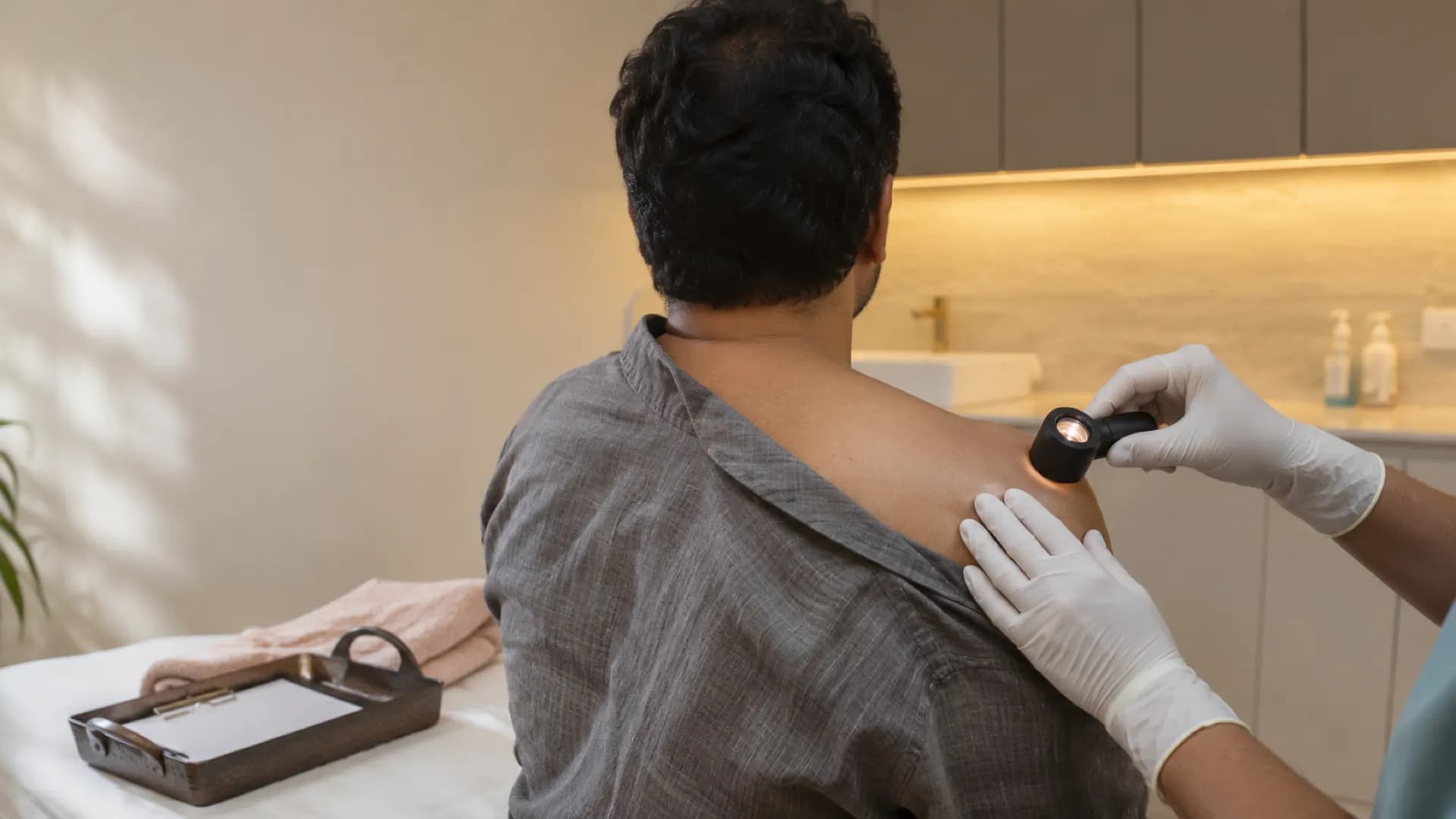
Skin tag removal is simple. Mole removal starts with an examination.
Skin tags are harmless folds of skin that a doctor can remove in clinic. A mole is examined first, because a few are early melanoma.
Two taps, then WhatsApp. A doctor reviews your history before any treatment is suggested.
4.9 from 1,238 Google reviews(Delhi centre)Doctor-led since 2004
Skin Tag and Mole Removal at a glance
- Skin tags
- Harmless, removed in clinic
- Moles
- Examined before any removal
- Methods a doctor weighs
- Snip, heat, freezing, laser, excision
- Testing
- A removed mole can be examined
- Healing
- A small wound or crust, then a mark
- Cost
- Set after examination
What these figures mean
- Skin tags
- A doctor confirms it is a skin tag first. Removal is for comfort or appearance, not for health.
- Moles
- A mole that is new, changing, bleeding or uneven is biopsied or referred before it is removed.
- Methods a doctor weighs
- The type, size and site of the growth, and your skin, decide the method.
- Testing
- A shaved or cut-out mole can go for histopathology. Burning or lasering leaves nothing to test.
- Healing
- Every removal leaves some mark. In Indian skin it can be dark first and fade over months.
- Cost
- It depends on the number, size, site and method. Your doctor confirms it in writing before you begin.
Updated
The short answer
Skin tags are harmless, and a doctor can remove them in a short clinic visit. A mole is different: a doctor examines it first, because a few moles are early melanoma, and one that is changing, bleeding or irregular is biopsied or referred before any removal. Snipping, radiofrequency or electrocautery, freezing, CO2 laser and excision are the methods a doctor may weigh, and every one leaves a mark that can darken first in Indian skin. Warts are a viral infection and have their own page.
Is skin tag or mole removal right for you?
Often suits
- Skin tags that catch on clothing, a collar, jewellery or a razor, bleed or bother you, once a doctor has confirmed they are skin tags.
- Skin tags in the neck, armpit or groin folds that you want removed for appearance.
- Moles you want removed for comfort or appearance, after a doctor has examined them and judged them benign.
- Small dark bumps on the cheeks or around the eyes that a doctor identifies as dermatosis papulosa nigra, a common harmless condition in darker skin.
May not suit
- A mole or dark spot that is new, changing, bleeding, itchy, crusting or uneven. It needs examination, and often a biopsy or a referral, before any removal.
- Anyone planning to remove a growth at home with thread, nail clippers, acids, tape or a blade. Bleeding, infection, scarring and a missed diagnosis are the risks.
- Anyone who wants a mole burned or lasered away when a doctor has said it needs testing. Those methods leave nothing to examine.
2 more reasons
- Skin that is infected, irritated or freshly tanned at the site, or a history of raised keloid scars. Tell your doctor so the plan can be adjusted.
- Pregnancy or breastfeeding. Skin tags can change in pregnancy, many removals are deferred, and a doctor decides.
Skin tag and mole removal methods: what a doctor weighs
These growths are made differently, so they are removed differently. A skin tag is a soft piece of skin on a small stalk that forms where skin rubs, in folds such as the neck and armpits, and it is more common with weight gain, diabetes and pregnancy. A mole is a cluster of pigment cells that can reach deeper than the surface, and a few are early melanoma, which is why a doctor examines it, sometimes with dermoscopy, a lit magnifying examination. For a skin tag, a doctor may weigh snipping with scissors, radiofrequency or electrocautery heat, freezing or CO2 laser. For a mole, the methods are shave excision, level with the skin, or full excision with stitches, and sometimes laser or heat for a mole judged benign. Excision and shaving give a sample for histopathology, a laboratory examination under a microscope, which is why a doctor may choose them for a mole. In Indian skin (Fitzpatrick III to V), any wound can leave a dark mark, and some people form raised keloid scars, so the method is chosen with care.
How care runs at Clinic Eximus
The same order for everyone, so nothing is decided before the cause is clear.
Step 1
Examination before anything else
Your doctor asks how long each growth has been there, whether it has changed, bled or itched, and about your skin and medical history. Every growth is examined closely, with magnification where needed.
Step 2
Leave it, remove it, or test it first
A skin tag can be left alone or removed. A mole that raises a question is biopsied or referred before any removal. A mole judged benign can be removed for comfort or appearance.
Step 3
A written plan with the price
If removal suits you, the plan sets out the method and why, how many growths and visits, whether tissue will be sent to a laboratory, and the price. Nothing is done until you agree.
Step 4
Removal by the chosen method
The skin is cleaned and numbed where needed, then the growth is snipped, heated, frozen, lasered or excised. A removed mole can be sent for histopathology if your doctor advises it.
Step 5
Aftercare and review
You receive written aftercare for the small wound. A result visit is arranged if tissue was tested, and marks are checked as they settle.
What the research says
Published studies and guidelines, linked so you can read them yourself. Evidence is not a promise for any one person.
46 studies · 4,201 moles. A review of 46 studies and 4,201 moles found surgical excision cleared 96.4% with 2.1% recurrence. Shave excision cleared 85.7% (10.7% recurrence), CO2 laser 82.9% (12.9%) and electrosurgery 78.2% (16.1%). Patients rated the laser scars higher than excision scars. (Aesthetic techniques for melanocytic naevus management: systematic review and meta-analysis (PMC13261504), 2026) opens in a new tab
204 moles · 3 months. In 204 moles shaved and followed for three months, pigment or the mole returned in 19.6%, and 98% of patients said the scar looked better than the mole. Scars were more likely to be imperceptible on the face. Three months is short follow-up. (Shave excision of common acquired melanocytic naevi: cosmetic outcome, recurrences and complications, Dermatologic Surgery (PubMed 16164859), 2005) opens in a new tab
37 of 503 melanoma patients. Among 503 people treated for lentigo maligna melanoma, 37 (7.4%) had a cosmetic treatment of the lesion first, and 6 of them had invasive disease. It is a hospital series of melanoma patients, not a rate for moles, but it shows why a suspicious spot is examined before it is destroyed. (Lentigo maligna melanoma with a history of cosmetic treatment (PMC5643209), 2017) opens in a new tab
5 more studies
100 studies · dermoscopy. In a review of 100 studies, experienced dermatologists using dermoscopy, a lit magnifying examination of the skin, had 5.7 times the odds of a correct melanoma diagnosis compared with examination by eye alone. Examination improves accuracy; it does not replace a biopsy. (Skin cancer diagnosis by lesion, physician and examination type: systematic review and meta-analysis, JAMA Dermatology, 2024) opens in a new tab
68 people · 1,257 tags. In 68 people with 1,257 skin tags, scissor snip healed completely in 85% at 12 weeks against 71% for a 532 nm laser, with lower pain scores. The laser caused more redness and pigment change. It is one trial of tags on the neck and armpit. (Skin tags: scissor excision versus 532 nm laser, randomised trial, Archives of Dermatological Research (PubMed 40347285), 2025) opens in a new tab
32 tags per group · 3 months. In a blinded trial with 32 skin tags per group, electrosurgery gave higher doctor and patient satisfaction than freezing over three months. Lighter patches followed freezing in 4 of 64 and a thin dip in the skin followed electrosurgery in 2 of 64, a difference too small to count as real. Follow-up was short. (Cryotherapy versus electrosurgery for sebaceous hyperplasia, seborrheic keratosis, cherry angioma and skin tag: blinded randomised trial, Health Science Reports (PMC11541056), 2024) opens in a new tab
Review · skin tags, blood sugar. A review of skin signs linked to insulin resistance included skin tags as a possible marker, but the strength of the link varied between studies. A tag does not diagnose diabetes, though a doctor may ask about weight and blood sugar. (Cutaneous stigmata associated with insulin resistance and increased cardiovascular risk, International Journal of Dermatology (PubMed 24697530), 2014) opens in a new tab
137 people · mostly type V. In 137 people, mostly with Fitzpatrick type V skin, who had small dark facial bumps treated with low-intensity electrodesiccation, every person had post-inflammatory darkening at one month. It took a mean of about 159 days to clear. Scarring was uncommon, 2 of 137 at one year. (Low-intensity electrodesiccation for dermatosis papulosa nigra in African patients (PMC11837235), 2024) opens in a new tab
We will tell you if skin tag and mole removal is not the right first step for you.
From examination to healed skin
Typical milestones from published studies and guidelines. Your doctor sets your own schedule.
Visit 1
Examination, history and a written plan with the price
Removal
Numbing where needed, then removal by the chosen method
First days
A small wound or crust forms; follow your written aftercare
Weeks to months
The mark fades slowly and may darken first in Indian skin
Review
Tested moles get a result visit; marks are checked as they settle
What to expect
- Every removal leaves a mark of some kind. A flat pale or pink mark is common, and a face usually heals less visibly than a body site.
- In Indian skin the mark can be dark before it fades. In the study above, darkening cleared in about five months on average.
- A shaved mole can regrow some pigment, because cells can lie deeper than the cut. Excision has the lowest recurrence in the review, with a line scar and stitches.
- Removing a skin tag does not stop new ones. They can appear again in the same folds, and a doctor may ask about weight and blood sugar.
Side effects and safety
- Moles carry the main risk, a missed melanoma. The ABCDE signs are Asymmetry, an irregular Border, uneven Colour, a Diameter over about 6 mm, and Evolving, meaning changing. A mole that is new in adulthood, bleeds, itches or crusts also needs checking, and a doctor may biopsy it or refer you.
- A removed mole can be sent for histopathology. Whether yours should be is a doctor's decision. Burning or laser leaves nothing to test, so a suspicious mole is not treated that way.
- Do not remove a skin tag or mole at home with thread, clippers, acids, tape or a blade. Bleeding, infection, scarring and missing a melanoma are the risks, and creams can burn the skin around a tag.
- Skin cancer happens in brown and black skin too, so a changing mole is checked whatever your skin colour.
- Indian skin (Fitzpatrick III to V) is more prone to dark marks after burning, laser and freezing, and some people form keloid scars. Tell your doctor if you or your family have formed keloids, and use sun protection on healing skin.
- Redness that spreads, pus, increasing pain or fever after removal needs a prompt review. Tell your doctor about a pacemaker or implanted device, blood thinners, allergy to local anaesthetic, pregnancy and breastfeeding.
Skin tag and mole removal cost in Delhi and Noida
Your cost depends on the cause and the plan your doctor writes, which shows the full price before you begin.
What changes the cost
- How many skin tags or moles are treated, and their size.
- The site: the face, eyelids and groin need more care than the trunk.
- The method chosen, and whether numbing or stitches are needed.
- Laboratory examination of a removed mole, where a doctor advises it, which may be a separate charge.
- A biopsy first, if a mole needs one, before any removal.
- Review visits, including a result visit.
Questions people ask
How much does skin tag removal cost in Delhi?
There is no single price. Cost depends on how many tags are treated, their size and site, the method used and any numbing, and whether a review visit is needed. Online prices vary widely, and a quote without an examination is not reliable, because a doctor must first confirm that a growth is a skin tag and not something else. Your doctor confirms the plan and final price in writing at consultation.
How much does mole removal cost, and is the lab test extra?
Cost depends on the size and site of the mole, how many are treated, the method, and whether the removed mole is sent for histopathology, which may be a separate laboratory charge. A mole a doctor wants examined is shaved or cut out, not burned. Ask at consultation what the plan includes before you agree. Your doctor confirms the final price in writing.
Is mole removal safe, and will the doctor check the mole first?
Yes, a doctor examines every mole before removal, because a few moles are early melanoma and removing one without looking can hide it. Most moles are harmless, and removal for comfort or appearance is routine for a doctor. If anything looks unusual, you will be offered a biopsy or a referral instead of a quick removal.
What are the warning signs that a mole should be checked?
Doctors use ABCDE: Asymmetry, an irregular Border, uneven Colour, a Diameter over about 6 mm, and Evolving, meaning any change in size, shape or colour. A mole that is new, bleeds, itches, crusts or looks different from your others also needs checking. Skin cancer happens in brown and black skin too, so do not wait because your skin is dark.
Does mole removal leave a scar?
Yes, some mark is expected, because the skin heals a wound. Shaving usually leaves a flat pale or pink mark, and full excision leaves a thin line with stitches. In Indian skin the mark may be dark before it fades over months. A doctor chooses the method for the site and your skin, and gives written aftercare to reduce the risk.
Can I remove a skin tag at home with thread or a cream?
It is not advised. Tying thread or cutting a tag at home can cause bleeding, infection and scarring, and creams can burn the skin around it. The American Academy of Dermatology says skin tags are harmless and usually need no removal. If one bothers you, a doctor can remove it quickly in clinic, and confirm it is a skin tag first.
Do skin tags come back after removal?
The removed tag does not return, but new ones can form in the same folds, because they appear where skin rubs and are more common with weight gain, diabetes and pregnancy. Removal treats the tag, not the tendency. In a trial of 68 people with 1,257 tags, scissor snip healed completely in 85% at 12 weeks.
Will a removed mole be tested?
Only if your doctor advises it. A shaved or excised mole can be sent for histopathology, a laboratory examination under a microscope that shows what the cells are. Moles burned or lasered leave nothing to test, so a mole that could be suspicious is not treated that way. Ask at consultation whether testing is advised for your mole and what it costs.
Are skin tags a sign of diabetes?
Skin tags are harmless in themselves, but they are studied as a possible marker of insulin resistance. A 2014 review found the strength of the link varied between studies, so a tag does not mean you have diabetes. A doctor may ask about weight, family history and blood sugar when you come to have tags removed. Tags are also common in skin folds and in pregnancy.
Does removal leave dark marks or keloids in Indian skin?
It can. Indian skin (Fitzpatrick III to V) is more prone to dark marks after burning, freezing and laser. In 137 people, mostly with type V skin, treated with electrodesiccation for small facial bumps, every person had darkening at one month, and it took about 159 days on average to clear. Some people form raised keloid scars, so tell your doctor if you or your family have.
Read next

Article
Dark Spots on Face: Causes, Types and What Helps
How to tell sun spots, marks left by acne and melasma apart, why depth in the skin matters, and what a doctor may suggest.

Article
Is Laser Lip Treatment Safe for Indian Skin?
Laser lip treatment is usually well tolerated in small studies, but cold sores, patchy colour and darkening on Indian skin are real risks. Who should wait.
Article
Pimple Treatment: Options, What Works, and When to See a Doctor
What helps active acne, what does not, which medicines are a doctor's decision and how to avoid scars. For marks and dips that remain, see acne scar treatment.

Have a mole examined before you have it removed.
A doctor looks at your skin and your goals, then writes a plan with the full price before you begin.
Choose aesthetic care, a centre and a time
Two taps. Nothing is stored on the website.
Your message opens in WhatsApp
You send it yourself and can add anything for the doctor.
The team confirms your visit
Your doctor reviews your history before suggesting anything.
4.9 from 1,238 Google reviews(Delhi centre)Doctor-led since 2004