
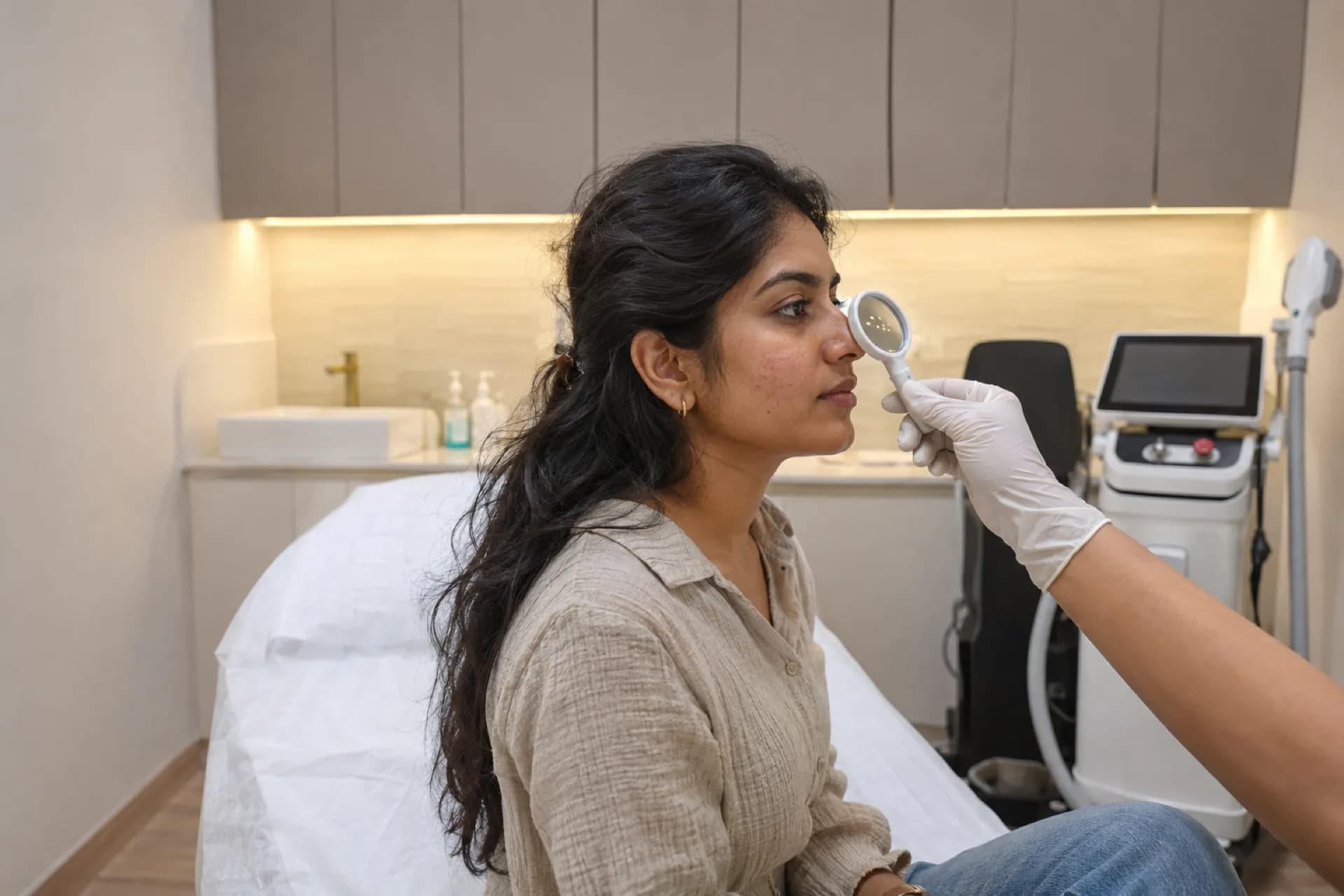
Open pores treatment: what can make pores less visible.
Pores are openings, so they cannot be closed. A doctor can look at why yours are noticeable (oil, congestion, sun damage or age) and match a plan to the cause.
Two taps, then WhatsApp. A doctor reviews your history before any treatment is suggested.
4.9 from 1,238 Google reviews(Delhi centre)Doctor-led since 2004
Open Pores Treatment at a glance
- Can pores close?
- No
- Main driver
- Oil output
- Typical plan
- Daily care plus sessions
- Downtime
- Depends on the route
- When to judge
- Weeks to months
- Cost
- Set after assessment
What these figures mean
- Can pores close?
- They can look less visible. DermNet NZ and a 2023 review agree.
- Main driver
- The factor most linked to pore size in a 60-person study.
- Typical plan
- A 2023 review of 19 trials favoured combined, repeated treatment.
- Downtime
- Skin care needs none. Mild burning and redness were common after procedures.
- When to judge
- Studies measured at 8 weeks up to 6 months.
- Cost
- If a Hydrafacial is part of your plan: ₹5,000–₹12,000 a session in Delhi NCR.
Updated
The short answer
Pores cannot be closed or shrunk for good, because they are the natural openings of hair follicles and oil glands. They can look smaller when oil output is controlled, plugs are cleared and the skin around them stays firm. A doctor works out which applies to you, then combines daily skin care with in-clinic options where they fit. Results vary and need upkeep.
Is open pores treatment right for you?
Often suits
- People bothered by visible pores on the nose, cheeks or forehead, especially with oily or combination skin.
- People with blackheads or congested skin who want a doctor to check for acne first and match a plan to it.
- People whose pores look more noticeable with age or sun damage and who want to discuss options for skin firmness.
- Anyone willing to combine a daily routine with a course of sessions and a review.
May not suit
- Anyone hoping to close pores permanently. No treatment does this.
- Active, inflamed acne or a rosacea flare, where that needs treating first.
- Pregnancy or breastfeeding, when a doctor decides and many in-clinic treatments are deferred.
3 more reasons
- Recent isotretinoin, peels or lasers, or very reactive skin. Your doctor decides the timing.
- Skin that marks easily. Indian skin (Fitzpatrick III to V) is more prone to dark marks after peels, lasers and irritation, so stronger options need more caution.
- Pits that are actually acne scars, which are assessed and treated differently.
Why pores look open, and what changes it
A pore is the mouth of a hair follicle, and the oil gland beside it sends sebum up through it to the surface. Three things mostly decide how large a pore looks: how much oil the gland makes, how big the follicle is, and how firm the skin around it stays. Oil output is the factor most strongly linked to larger pores in measured studies. Pores also look larger with age and sun damage, when plugged with oil and dead cells, and in women around ovulation. DermNet NZ notes that people of Indian ancestry may naturally have larger pores. Pores are not doors that open and shut, so the aim is never to close them. It is to change how visible they are, and because the causes differ, so does the plan.
The pore opening · the mouth of a hair follicle, where oil leaves the skin
The oil gland · sebum output is the factor most linked to pore size
The plug · oil and dead cells; the dark tip of a blackhead is oxidised oil
The skin around it · sun damage and ageing loosen it, so pores look larger
A pore is an opening, not a door. It can look smaller; it cannot be shut.
Sources: DermNet; Lee et al., Dermatologic Surgery, 2016; Roh et al., British Journal of Dermatology, 2006
How care runs at Clinic Eximus
The same order for everyone, so nothing is decided before the cause is clear.
Step 1
Skin assessment
Your doctor looks at oil levels, blackheads, any acne, sun damage and skin firmness, and at the products you use now. Photographs give a baseline for later comparison.
Step 2
A daily routine first
A gentle cleanser, a non-comedogenic moisturiser and daily sunscreen come first. Your doctor may add a prescribed or over-the-counter active and explains how to introduce it, because irritation makes pores look worse.
Step 3
In-clinic options if they fit
Where congestion or texture is the problem, your doctor may discuss a Hydrafacial-type extraction session, a peel or a microneedling-based treatment. Which of these suit you, and which the centre offers, is confirmed at consultation.
Step 4
Review with photographs
Progress is judged against your starting photographs in the same light. The plan is changed, paused or stopped if it is not helping.
What the research says
Published studies and guidelines, linked so you can read them yourself. Evidence is not a promise for any one person.
60 people · oil output. In 60 volunteers, higher oil (sebum) output was the factor most linked to larger pores, followed by male sex and age. Pores were also larger around ovulation in women. Acne severity was not linked to pore size. (Roh et al., Sebum output as a factor contributing to the size of facial pores, British Journal of Dermatology (PubMed 17034515), 2006) opens in a new tab
3 main causes. A review names three main causes of enlarged pores: high oil excretion, less elasticity around the pore and larger hair follicle volume. Because the causes differ, treatment needs to be individualised. (Lee et al., Facial pores: definition, causes and treatment options, Dermatologic Surgery (PubMed 26918966), 2016) opens in a new tab
19 trials · 591 people. A review of 19 clinical trials (591 people) found that several sessions and combined treatments improved pore area and number. Mild, reversible burning and redness were the usual side effects. (Parvar et al., The efficacy and adverse effects of treatment options for facial pores: a review, Journal of Cosmetic Dermatology (PubMed 36440737), 2023) opens in a new tab
2 more studies
Creams alone: limited effect. DermNet NZ rates measures aimed at preventing or shrinking pores, such as retinoids, peels and nicotinamide, as not very effective. It lists lasers, radiofrequency microneedling and some oral acne medicines as options that may help. (DermNet NZ: enlarged pores, 2017) opens in a new tab
Daily care comes first. The American Academy of Dermatology advises gentle twice-daily cleansing with non-comedogenic products, daily sunscreen of SPF 30 or higher, and never scrubbing, picking or squeezing, all of which stop pores looking larger. (American Academy of Dermatology: what can treat large facial pores?, 2026) opens in a new tab
We will tell you if open pores treatment is not the right first step for you.
Your first six months
Typical milestones from published studies and guidelines. Your doctor sets your own schedule.
Week 0
Assessment, photographs and a simple daily routine
Weeks 2–4
Check the routine suits your skin; irritation settles
Weeks 4–12
In-clinic sessions, if your doctor plans them
Month 3
First fair review against your starting photographs
Month 6
Decide on upkeep; effects fade if causes continue

What to expect
- Pores cannot be closed or removed. The goal is to make them less visible, and that usually takes daily care plus, where suitable, a course of sessions.
- Change is gradual. Studies measured results at 8 weeks up to 6 months, so judge a plan over months, not one visit.
- Upkeep matters. Pores look larger again if oil, congestion or sun damage are not kept in check.
- Treatments aimed at shrinking pores through creams alone have limited effect, so combined plans are common.
- If the marks you notice are pits, they may be acne scars, which need a different assessment.
Side effects and safety
- Mild burning, dryness and redness are common with active creams and procedures. In the 2023 review of 19 trials, these usually cleared up.
- Indian skin is more prone to dark marks after irritation, peels and lasers, so a doctor chooses strength carefully and pairs any plan with daily sunscreen.
- Do not scrub, pick or squeeze pores. The AAD notes this irritates skin and makes pores look larger.
- Tell your doctor if you are pregnant or breastfeeding, or have used isotretinoin recently, before any active or procedure is planned.
- Contact the clinic if redness or stinging lasts more than a few days or skin darkens.
Open pores treatment cost in Delhi
Your cost depends on the cause and the plan your doctor writes, which shows the full price before you begin.
What changes the cost
- The route your doctor suggests. Daily skin care alone costs less than a course of in-clinic sessions.
- How many sessions are planned, and whether upkeep is suggested.
- Whether acne or another skin condition is treated alongside.
- If a Hydrafacial is part of the plan, its indicative range in Delhi NCR is ₹5,000–₹12,000 per session.
Questions people ask
Can open pores be closed permanently?
No. Pores are the natural openings of hair follicles and oil glands, so they cannot be closed, and anyone who promises this is overselling. What can change is how visible they are: controlling oil, clearing plugs, protecting skin from the sun and, where suitable, in-clinic treatment can make them look smaller. Your doctor will explain what is realistic for your skin.
What causes open pores on the face?
Mainly oil. In a 60-person study, higher sebum output was the factor most linked to larger pores. Others include larger hair follicles, less elasticity around the pore with age and sun damage, blocked pores with blackheads, and hormones: pores can look wider around ovulation. People of Indian ancestry may naturally have larger pores. Your doctor can tell which causes apply to you.
What treatment helps open pores?
It depends on the cause. Daily care comes first: a gentle cleanser, non-comedogenic moisturiser and sunscreen. A doctor may add a retinoid, or discuss in-clinic options such as extraction facials, peels or microneedling-based treatment. A 2023 review of 19 trials found that several sessions and combined treatments improved pore area and number. Your doctor decides what suits you.
Is a facial good for open pores?
A facial can clear blackheads and surface oil, so pores look cleaner for a while. It cannot change pore size, and the effect fades as oil returns. Gentle extraction can suit congested skin, but scrubbing or squeezing irritates skin and makes pores look larger. A Hydrafacial-type session can sit in a wider plan your doctor sets.
What is the cost of open pores treatment in Delhi?
There is no single price, because the plan depends on the cause and the route. Daily skin care costs less than a course of in-clinic sessions. If a Hydrafacial is part of your plan, it is indicatively ₹5,000 to ₹12,000 per session in Delhi NCR. Your doctor confirms the plan and final price in writing at consultation.
Do home remedies like multani mitti or besan shrink pores?
We found no good trial evidence that they do. Clay may soak up surface oil for a few hours, which can make pores look tidier, but it does not change pore size. Gritty scrubs and rubbing can irritate skin, and the AAD warns that irritation makes pores look larger. A gentle cleanser, moisturiser and daily sunscreen are a safer start.
Do pores get bigger with age?
They can look larger. DermNet NZ notes pores often appear larger with age, and the AAD links this to sun damage and sagging, which reduce the firmness around the pore. Daily sunscreen from early on helps. Pores in younger people are more often about oil, which is why plans differ by age. Your doctor can advise on both.
Is open pores treatment safe for Indian skin?
Options exist for Indian skin, but the risk of dark marks after irritation, peels and lasers is higher in skin types III to V. That is why a doctor assesses your skin first, starts gently, and pairs any plan with sunscreen. Tell your doctor if your skin marks easily or if you are pregnant or breastfeeding.
Read next
Article
Which Facial Suits Your Skin? A Guide by Skin Concern
Dry, oily, acne-prone, dull or sensitive: what each skin type needs from a facial, what to be careful with, and when to see a doctor first.
Article
Hydrafacial Benefits and Disadvantages: What the Evidence Shows
What a Hydrafacial can and cannot do, how strong the evidence is, the side effects to expect and who should be cautious or wait.
Article
Pimple Treatment: Options, What Works, and When to See a Doctor
What helps active acne, what does not, which medicines are a doctor's decision and how to avoid scars. For marks and dips that remain, see acne scar treatment.

Start with why your pores look open.
A doctor looks at your skin and what is behind the concern, then writes a plan with the full price before you begin.
Choose skin care, a centre and a time
Two taps. Nothing is stored on the website.
Your message opens in WhatsApp
You send it yourself and can add anything for the doctor.
The team confirms your visit
Your doctor reviews your history before suggesting anything.
4.9 from 1,238 Google reviews(Delhi centre)Doctor-led since 2004