
Dandruff treatment starts with a diagnosis, not another shampoo.
Flaking can be dandruff, seborrhoeic dermatitis, psoriasis, a fungal infection or a reaction to a product. A doctor tells them apart, treats the cause and plans for the times it returns.
Two taps, then WhatsApp. A doctor reviews your history before any treatment is suggested.
4.9 from 1,238 Google reviews(Delhi centre)Doctor-led since 2004
Dandruff and Scalp Treatment at a glance
- First step
- A look at the scalp
- Judge a first plan at
- About 4 weeks
- Usual pattern
- Controlled, then it returns
- Downtime
- None
- See a doctor sooner for
- Redness, oozing, patches, children
What these figures mean
- First step
- Dandruff, dry scalp, seborrhoeic dermatitis, psoriasis, fungal infection and product reactions are treated differently.
- Judge a first plan at
- Trials of medicated shampoos measure the result at about 4 weeks. No change means a review, not more of the same.
- Usual pattern
- It is long-term and relapsing, so a maintenance routine is part of the plan.
- Downtime
- Treatment is shampoos and lotions at home. Stinging or dryness is possible.
- See a doctor sooner for
- Thick plaques, patchy hair loss, or scaly patches with broken hair in a child should not wait.
Updated
The short answer
Dandruff is itchy flaking from a scalp that reacts to Malassezia, a yeast that lives on most scalps, along with oil and individual sensitivity. It is not caused by poor hygiene and is not contagious, and it often relapses. Seborrhoeic dermatitis, psoriasis, dry scalp, contact dermatitis and a fungal infection (tinea capitis) can look the same but need different treatment, so a doctor looks first.
Is it dandruff, or something that looks like it?
Often suits
- People whose flaking or itch has come back after anti-dandruff shampoos, or has not eased after about four weeks.
- People with a red, greasy or inflamed scalp, especially with flaking at the eyebrows, nose creases or behind the ears, which suggests seborrhoeic dermatitis.
- People who cannot tell whether it is dandruff, a dry scalp, psoriasis or a reaction to a new dye or oil, and who want it looked at before spending more on products.
- People who have used steroid creams, home mixtures or products of unknown content on the scalp and want a safe plan.
May not suit
- Mild loose flaking that settles with a pharmacy anti-dandruff shampoo in a few weeks may not need a clinic visit at all.
- A child with a round scaly patch, broken hairs or small black dots needs a doctor promptly, because scalp ringworm is contagious and needs prescribed medicine.
- Thick, sharply edged silvery plaques, nail changes or joint pain point to psoriasis, which has its own plan (see the psoriasis page).
3 more reasons
- Spreading redness, oozing, pus, painful lumps, fever, or burning and blisters after a new dye or product need prompt medical care.
- Patchy bald spots, a widening parting or sudden heavy shedding is a hair-loss question first, with its own assessment.
- In pregnancy and breastfeeding a doctor decides which medicines and shampoos are suitable.
How dandruff treatment works: shampoo ingredients, and why it comes back
Dandruff is not dirt. A yeast called Malassezia lives on the scalp of most adults and feeds on the oil the skin makes. It releases enzymes that turn scalp oil into fatty acids, and in people who are prone to it those fatty acids irritate the surface, speed up shedding and make the scalp itch. The skin barrier and the immune response of the individual matter as much as the yeast, which is why two people with the same yeast can have very different scalps. Dandruff and seborrhoeic dermatitis are one spectrum, with redness marking the more inflamed end. Cold dry weather, stress, poor sleep, some illnesses and some medicines can bring flares. Medicated shampoos work in a few ways. Zinc pyrithione, ketoconazole and selenium sulfide act against the yeast. Salicylic acid softens thick scale so it washes off. Coal tar loosens scale and calms inflammation. When the scalp is red, a doctor may add a short course of an anti-inflammatory treatment. Look-alikes need other treatment: psoriasis, scalp fungus and product reactions do not respond to a shampoo alone.
Dandruff
Loose white or yellowish flakes, some itch, and no redness. It comes and goes.
Next: A medicated shampoo is the usual first step.
Dry scalp
Small, dry, powdery flakes and tightness, often with dry skin elsewhere or after hot washes and cold weather.
Next: Gentler washing and a moisturiser. Check if it does not settle.
Seborrhoeic dermatitis
Greasy, yellowish scale on pink or darker skin, often also at the eyebrows, nose creases or behind the ears.
Next: A doctor can treat the flare and the redness.
Scalp psoriasis
Thicker, sharply edged patches with silvery scale, sometimes beyond the hairline or on the elbows, knees or nails.
Next: Needs a doctor. Shampoo alone rarely clears it.
Fungal infection (tinea capitis)
A round, scaly patch with broken hairs or small black dots, sometimes tender or swollen, mostly in children.
Next: See a doctor soon. It needs prescribed medicine and can spread.
Contact dermatitis
A red, burning or itchy scalp after a new dye, shampoo or oil, sometimes with blisters or weeping, and often at the hairline.
Next: Stop the suspect product and see a doctor if it persists.
More than one can be present at once, and the look changes on brown and black skin, where redness shows as purple, brown or grey. This is a guide to what to ask about, not a diagnosis. A doctor examines the scalp, and sometimes takes a skin or hair sample, to be sure.
How care runs at Clinic Eximus
The same order for everyone, so nothing is decided before the cause is clear.
Step 1
Look at the scalp and ask
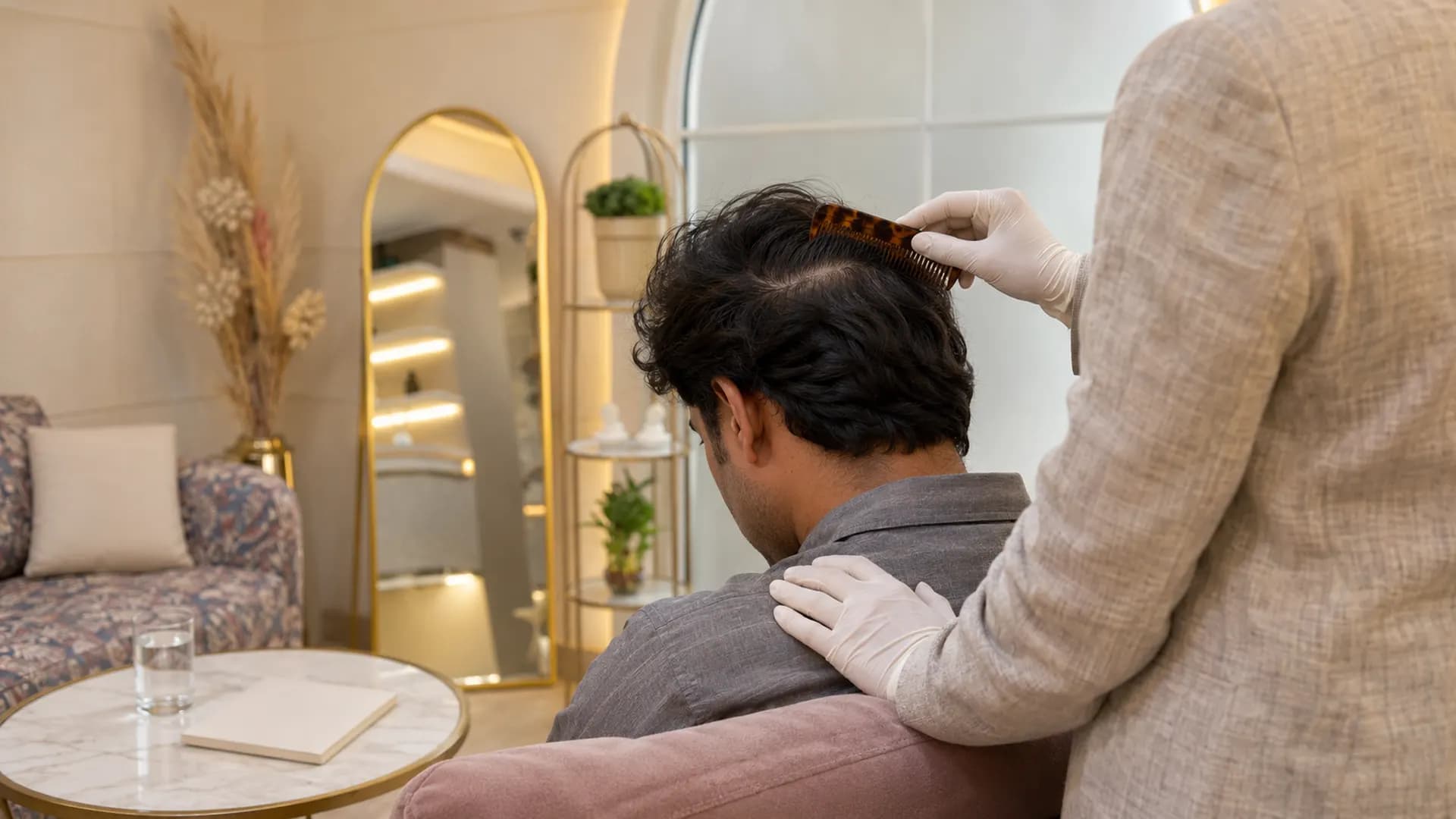
Your doctor examines the scalp and hairline, and asks when it started, what is washed or applied (shampoo, oil, dye, any cream), what medicines you take, and about stress, sleep and skin elsewhere, such as the eyebrows, ears, nose creases, elbows and nails.
Step 2
Rule out the look-alikes
Psoriasis, a fungal infection and a reaction to a product are separated from dandruff. Where infection is possible, a hair or skin sample may be taken to confirm it, and where an allergy is suspected, patch testing may be considered.
Step 3
Treat the cause
For dandruff this is usually a medicated shampoo, sometimes with a scale-softening step. If the scalp is red, a doctor may add a short course of an anti-inflammatory treatment. Psoriasis and infection have their own treatments.
Step 4
Review at about four weeks
If the scalp has not improved, the diagnosis or the product is reconsidered. Needing more of the same shampoo is not the answer, and hair thinning, if present, is assessed separately.
Step 5
Plan for the relapses
Because it tends to return, you leave with a maintenance routine, the triggers to watch for, and a clear point at which to come back.
What the research says
Published studies and guidelines, linked so you can read them yourself. Evidence is not a promise for any one person.
Review: one spectrum. A comprehensive review describes dandruff and seborrhoeic dermatitis as one spectrum. Dandruff is itchy scalp flaking without visible inflammation, while seborrhoeic dermatitis adds redness and can reach the face and chest. Oil, yeast on the skin and individual susceptibility all contribute. It notes a winter pattern and links to stress and poor sleep, and says seborrhoeic dermatitis is not contagious and not associated with hair loss, unlike tinea capitis, though thick crusting in severe adult scalp disease is described as able to lead to hair loss. (Borda and Wikramanayake, Seborrheic dermatitis and dandruff: a comprehensive review, Journal of Clinical and Investigative Dermatology (PubMed 27148560), 2015) opens in a new tab
12 studies · 706 samples. A systematic review of 12 studies, with 706 dandruff or seborrhoeic dermatitis samples and 379 healthy ones, found a higher ratio of Malassezia restricta to Malassezia globosa in affected skin and a lower ratio of Cutibacterium to Staphylococcus. Malassezia was linked to itch and to severity. It shows an association rather than a single cause, since Malassezia also lives on healthy skin. (Skin microbiome alterations in seborrheic dermatitis and dandruff: a systematic review, Experimental Dermatology (PubMed 34415635), 2021) opens in a new tab
154 isolates · northern India. In 154 Malassezia isolates from people with dandruff or seborrhoeic dermatitis and healthy people in rural and urban northern India, M. restricta and M. arunalokei were the main species behind dandruff, and some strains were specific to the disease or to a region. It is a laboratory typing study, not a treatment trial. (Molecular epidemiology of seborrheic dermatitis/dandruff associated Malassezia species from northern India, Medical Mycology (PubMed 39419782), 2024) opens in a new tab
8 more studies
343 people · 4 weeks. In a trial of 343 people with severe dandruff or seborrhoeic dermatitis, shampoos with ketoconazole and with zinc pyrithione both helped over 4 weeks, with improvements in the total severity score of 73% and 67%. The gap favoured ketoconazole, and relapse in the 4 weeks after treatment was lower. The trial was open, not blinded, and side effects were minimal. (A multicenter randomized trial of ketoconazole 2% and zinc pyrithione 1% shampoos in severe dandruff and seborrheic dermatitis, Skin Pharmacology and Applied Skin Physiology (PubMed 12476017), 2002) opens in a new tab
246 people · placebo-controlled. In 246 people with moderate to severe dandruff, shampoos with ketoconazole and with selenium sulfide both reduced dandruff scores more than a placebo shampoo and both eased itch and irritation. Ketoconazole was ahead of selenium sulfide only at day 8, and all nine adverse events reported during treatment were with selenium sulfide. The trial is from 1993. (A randomized, double-blind, placebo-controlled trial of ketoconazole 2% shampoo versus selenium sulfide 2.5% shampoo in the treatment of moderate to severe dandruff, Journal of the American Academy of Dermatology (PubMed 8245236), 1993) opens in a new tab
51 trials · 9,052 people. A Cochrane review of 51 trials with 9,052 people found ketoconazole carried a 31% lower risk of failed clearance than placebo at about 4 weeks (low-quality evidence), and ciclopirox also beat placebo (moderate quality). Ketoconazole cleared about as often as steroids, with fewer side effects. Most trials were short, and 24 had some conflict of interest, such as company funding. (Okokon et al., Topical antifungals for seborrhoeic dermatitis, Cochrane Database of Systematic Reviews (PubMed 25933684), 2015) opens in a new tab
36 trials · 2,706 people. A Cochrane review of 36 trials with 2,706 people found topical steroids cleared seborrhoeic dermatitis of the scalp or face more often than placebo in short trials (3 trials, 313 people), and about as often as azole antifungals. There was some evidence for calcineurin inhibitors. Risk of bias was often unclear, and the authors found mild and strong steroids comparable in the short term. (Topical anti-inflammatory agents for seborrhoeic dermatitis of the face or scalp, Cochrane Database of Systematic Reviews (PubMed 24838779), 2014) opens in a new tab
131 papers · expert consensus. An international expert group reviewed 131 papers and described scalp seborrhoeic dermatitis as chronic and relapsing, treated mainly with topical antifungal and anti-inflammatory agents. It noted that no therapies are approved for the moderate and severe forms and proposed a stepwise treatment algorithm. (A comprehensive literature review and an international expert consensus on the management of scalp seborrheic dermatitis in adults, European Journal of Dermatology (PubMed 38919137), 2024) opens in a new tab
25 trials · 4,449 children. A Cochrane review of 25 trials with 4,449 children states that tinea capitis, a contagious fungal infection of the scalp in children, needs systemic (oral) antifungal medicine, to treat it and to prevent spread. In infections caused by Trichophyton species, terbinafine and griseofulvin had similar complete cure rates (84.2% and 79.0%, low-quality evidence). (Systemic antifungal therapy for tinea capitis in children, Cochrane Database of Systematic Reviews (PubMed 27169520), 2016) opens in a new tab
59 trials · 11,561 people. A Cochrane review of 59 trials with 11,561 people looked at prescription scalp treatments for psoriasis. A corticosteroid and vitamin D analogue combination, and high-potency steroids, worked better than vitamin D alone, and the combination added only a small benefit over the steroid. Most trials lasted under 6 months. These are prescription preparations that a doctor chooses, not shampoos. (Topical treatments for scalp psoriasis: summary of a Cochrane systematic review, British Journal of Dermatology (PubMed 27312814), 2016) opens in a new tab
140 Indian women · 12 weeks. A 16-week study of 140 Indian women (70 healthy, 70 with dandruff) followed the scalp microbiome through 12 weeks of coconut oil and 4 weeks off. In dandruff scalps, Cutibacterium acnes and Malassezia globosa rose, and these correlated with lower dandruff measures. The abstract does not compare oil with a medicated shampoo, so it cannot show that oiling treats dandruff. (Longitudinal study of the scalp microbiome suggests coconut oil to enrich healthy scalp commensals, Scientific Reports (PubMed 33790324), 2021) opens in a new tab
We will tell you if dandruff and scalp treatment is not the right first step for you.
From first look to keeping it under control
Typical milestones from published studies and guidelines. Your doctor sets your own schedule.
First visit
Scalp examined; look-alikes ruled out; products and medicines reviewed
Weeks 1 to 4
Plan followed; itch and flaking usually start to ease
About week 4
Review: no change means a different diagnosis or treatment
After it clears
Maintenance routine to keep flares down
Later
Relapses are common; restart early and come back if it persists
What to expect
- Dandruff and seborrhoeic dermatitis are long-term and relapsing. The aim is to clear the flare and keep it controlled, not to remove it for good.
- A first plan is judged at about four weeks. Many trials measured the result at four weeks, and a shampoo you stop using too early may bring relapse sooner.
- No single ingredient is right for everyone. Trials show the antifungal shampoos work, with only small differences between them, and tolerance and your scalp matter as much.
- Treating dandruff does not regrow hair lost to pattern hair loss or another cause. If you are also losing hair, it needs its own assessment, and the hair fall pages explain the options.
- Flares often follow stress, poor sleep, cold dry weather and some illnesses and medicines, so an occasional flare does not mean the plan has failed.
Side effects and safety
- Medicated shampoos can sting, dry the scalp or hair, or cause irritation. A few can discolour hair or leave the scalp tinged. Stop a product that burns or swells the skin and tell your doctor.
- Do not put leftover steroid creams, antifungal creams or home mixtures on the scalp without advice. Lemon, vinegar, baking soda and undiluted oils can burn or inflame it, and steroids used without a plan can thin the skin and make a rash worse.
- Redness that spreads, oozing, pus, painful lumps, fever or burning and blisters after a new dye or product need prompt medical care.
- Scaly patches with broken hair, especially in a child, may be a fungal infection. It is contagious, needs prescribed medicine and should not be treated with shampoo alone.
- In pregnancy and breastfeeding, a doctor decides which medicines and shampoos are suitable, and many options are chosen with extra care.
Dandruff treatment cost in Delhi: what changes the price
Your cost depends on the cause and the plan your doctor writes, which shows the full price before you begin. In-clinic add-ons have published ranges: Hair PRP and GFC.
What changes the cost
- What the scalp problem turns out to be: dandruff, seborrhoeic dermatitis, psoriasis, an infection or a reaction to a product each need a different plan.
- Whether tests are needed, for example a hair or skin sample where infection is possible, or patch testing where an allergy is suspected.
- How many reviews you need, which depends on how the scalp responds in the first weeks.
- Whether hair thinning is also being assessed, which can add investigations and its own treatment plan. Prescribed medicines are separate from the consultation.
Pairs with this care
Care to use between visits, chosen by the clinic. Confirm the right one with a doctor.
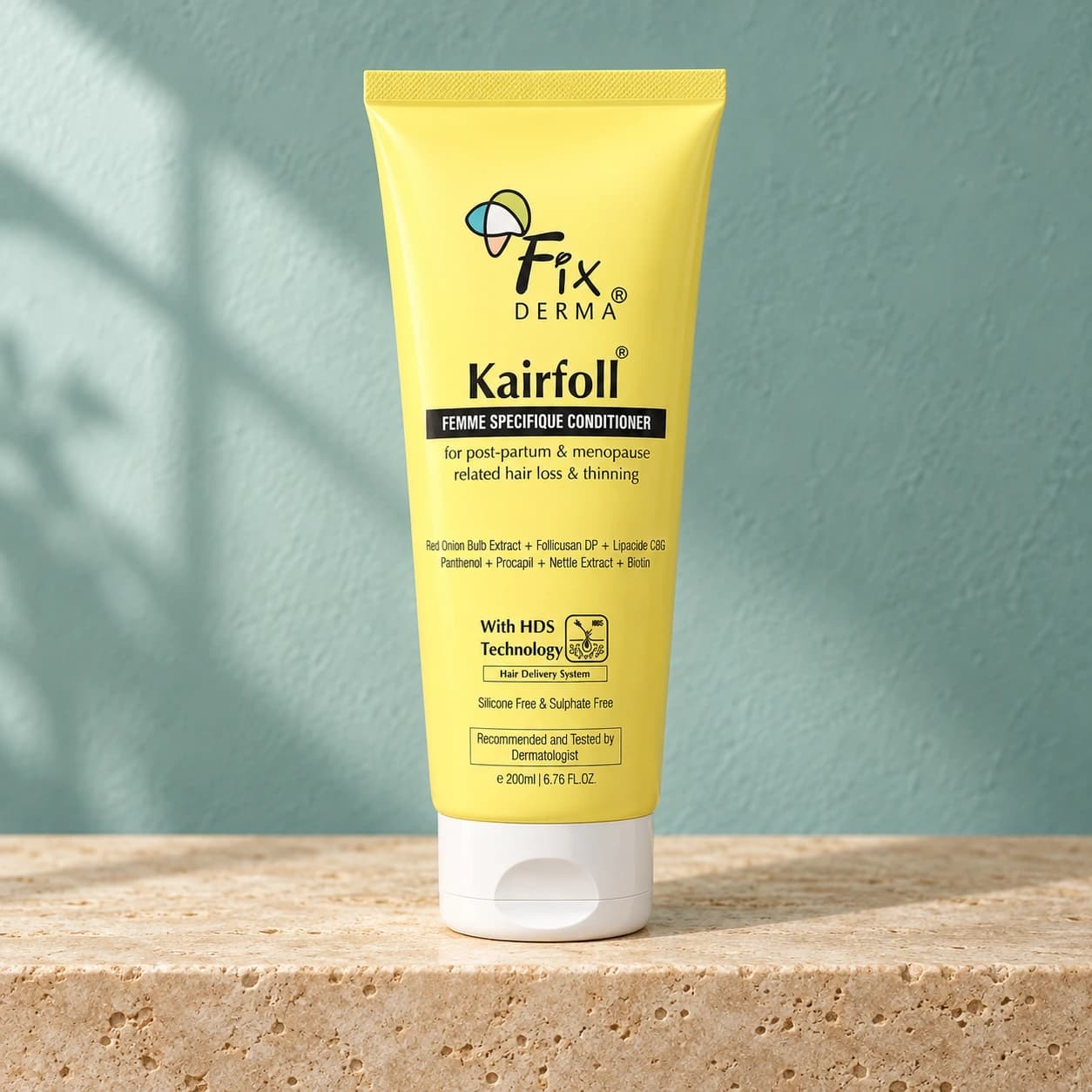
Shampoo
Fixderma Kairfoll Femme Specifique Conditioner
Hair conditioner for a clinic-guided hair care routine. Confirm the formulation and pack size.
₹825View details
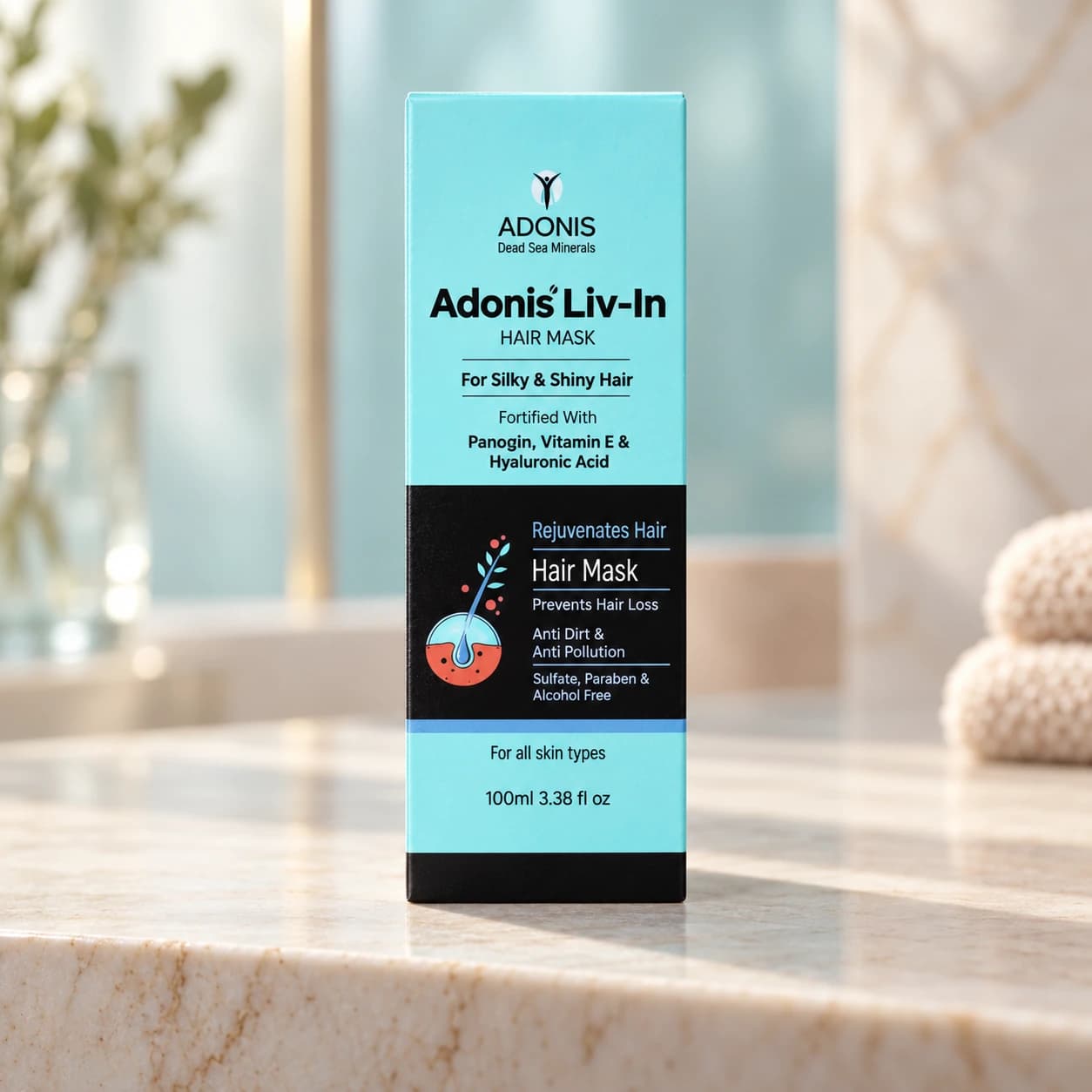
Mask
Adonis Liv-In Hair Mask
Hair mask for a clinic-guided conditioning routine. Confirm the formulation and directions.
₹796View details
Orders are confirmed on WhatsApp. There is no online payment.
Questions people ask
What is the difference between dandruff and seborrhoeic dermatitis?
They sit on the same spectrum. Dandruff is itchy flaking confined to the scalp, with no visible redness. Seborrhoeic dermatitis has the same yeast and oil behind it but adds redness and greasy, yellowish scale, and it can spread to the eyebrows, nose creases, ears and chest. Reviews treat them as one condition of varying severity. The difference matters because redness usually needs an anti-inflammatory treatment as well as an antifungal shampoo, which a doctor decides.
Is dandruff a fungal infection, and is it contagious?
Not in the way ringworm is. A yeast called Malassezia lives on most people's scalps and is part of the picture, but dandruff is a reaction in scalps that are prone to it, not an infection you catch. It is not contagious and it is not caused by poor hygiene. A true fungal infection of the scalp, tinea capitis, is different: it is contagious, causes scaly patches with broken hair, and needs prescribed medicine.
How do I tell dandruff from a dry scalp, psoriasis or a fungal infection?
Look at the flakes and the skin under them. Dandruff flakes are loose, white or yellowish, on skin that is not red. A dry scalp gives small, powdery flakes and tightness. Psoriasis makes thick, sharply edged, silvery patches. A fungal infection gives a round scaly patch with broken hairs. Redness, oozing or hair loss point away from simple dandruff. This is a guide, not a diagnosis, because they overlap and can occur together. A doctor examines the scalp to be sure.
Does dandruff cause hair fall?
Dandruff itself does not usually cause hair loss, and reviews describe seborrhoeic dermatitis as not associated with it. Heavy scratching, thick crusts or a different scalp problem can make hair shed or break. Flaking and thinning also often happen together by coincidence, since both are common. Patchy bald spots, a widening parting or sudden heavy shedding need their own assessment, not just a stronger shampoo. Treating dandruff does not regrow hair lost to another cause.
What does anti-dandruff shampoo do, and which ingredient is for what?
Most work in one of a few ways. Zinc pyrithione, ketoconazole and selenium sulfide act against the Malassezia yeast. Salicylic acid softens and lifts scale so it washes away, which helps thick flaking. Coal tar loosens scale and calms inflammation, and is usually kept for stubborn cases under advice. Trials show the antifungal ones work, with small differences between them. Which suits you depends on your scalp and whether there is redness, so ask a pharmacist or doctor rather than choosing by marketing.
How often should I wash my hair if I have dandruff?
Wash as often as your scalp needs, which for many people with dandruff is not less often. Flakes and oil build up if you wash rarely, although poor hygiene does not cause dandruff. A medicated shampoo does its job when it stays on the scalp for the time its label gives and is used for the whole course. How often to use it is set by the product and your doctor, and very frequent washing with harsh products can dry the scalp.
Does oiling help dandruff, or make it worse?
Oiling does not treat dandruff. It can trap scale and leave the scalp greasy, and Malassezia yeast breaks scalp oil into fatty acids that irritate scalps prone to dandruff. One 12-week study in 70 Indian women with dandruff saw microbe changes after coconut oil, but it did not compare oil with a medicated shampoo, so it cannot show that oiling works. If you oil, use a little and wash it out well.
Why does dandruff keep coming back?
Because it is a long-term, relapsing condition rather than an infection cleared once. The yeast and the oil are always there, so flaking returns when the scalp is under pressure from stress, poor sleep, cold dry weather, some illnesses or medicines, or when treatment stops. Treatment aims to control it: clear the flare, then follow a maintenance routine your doctor sets. Restarting early, at the first itch, is a common approach.
When should I see a doctor about dandruff?
See a doctor if there is no clear improvement after about four weeks of a medicated shampoo, or sooner for red, sore or swollen skin, oozing or crusting, thick silvery patches, patches of hair loss or broken hairs, or a rash on the face or body. Take a child with scaly patches promptly, because it may be a fungal infection that needs prescribed medicine. Also go if burning or blistering followed a new dye or product.
Can children get dandruff, or is it ringworm of the scalp?
Both happen. Babies can get cradle cap, greasy yellow scale on the scalp. Older children can get dandruff, but a round, scaly patch with broken hairs or small black dots is more likely ringworm of the scalp, which is contagious and needs prescribed medicine taken by mouth. Do not use leftover steroid or antifungal creams on a child's scalp. A doctor should see any child with patchy hair loss or scaly patches.
How much does dandruff treatment cost in Delhi?
No price is shown because it depends on what is found. Many cases need a consultation and a prescribed shampoo or lotion, while a scalp infection, psoriasis or a hair-loss assessment changes the plan and the number of reviews. Your doctor explains the plan and its cost before you begin, so you know what you are agreeing to.
Read next
Article
How to Stop Hair Fall: Find the Cause, Then Treat It
What counts as normal shedding, how to tell shedding from pattern hair loss, the common causes, what helps at home, and when to see a doctor.

Article
PCOS Hair Loss: Why It Happens and What Helps
How PCOS can thin your hair, how that differs from ordinary shedding, which tests help, and the treatments a doctor may discuss with you.

Four weeks, no change? Time to have the scalp looked at.
A doctor checks why your hair is changing, then writes a plan with the full price before you begin.
Choose hair care, a centre and a time
Two taps. Nothing is stored on the website.
Your message opens in WhatsApp
You send it yourself and can add anything for the doctor.
The team confirms your visit
Your doctor reviews your history before suggesting anything.
4.9 from 1,238 Google reviews(Delhi centre)Doctor-led since 2004