
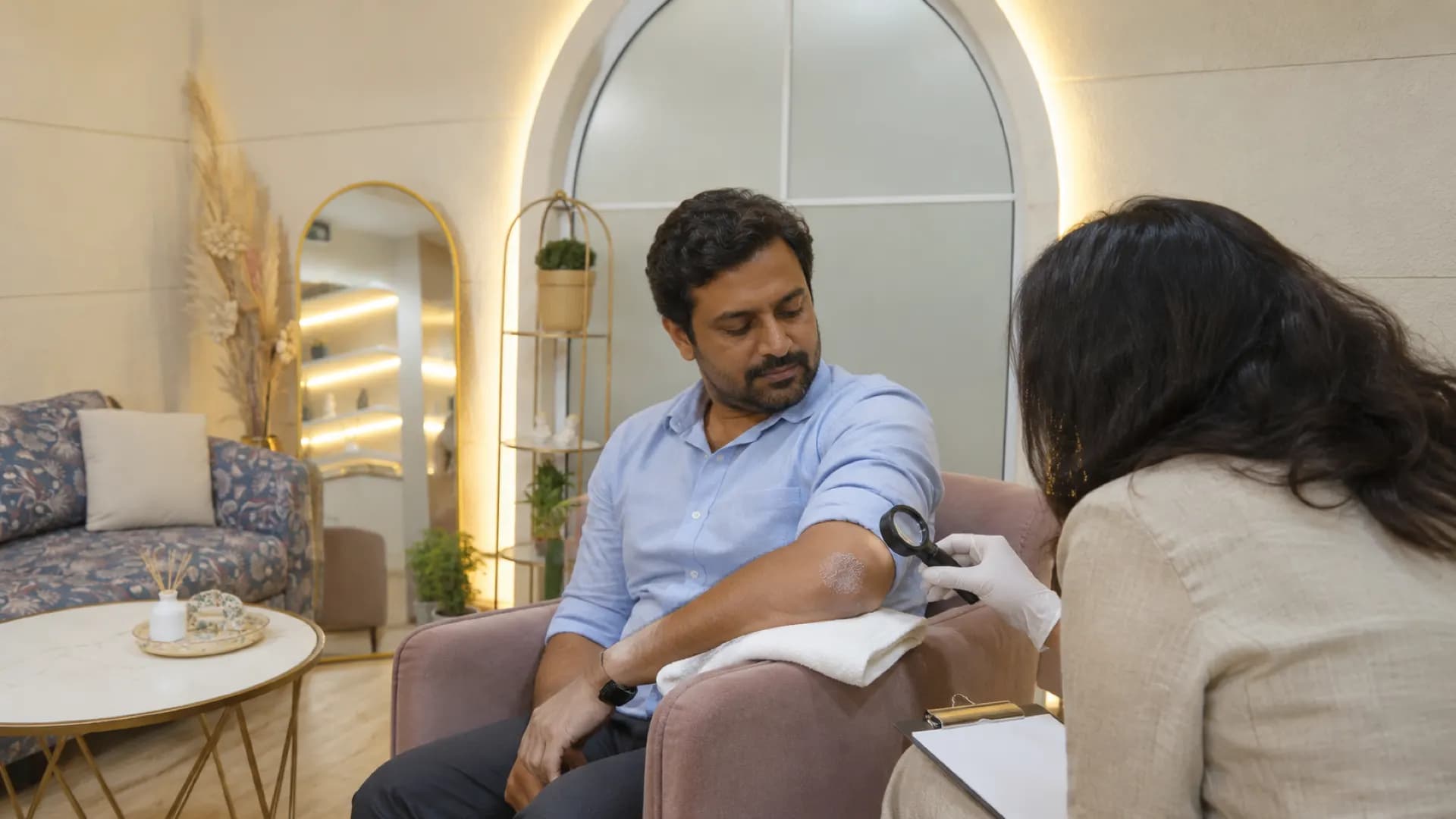
Psoriasis treatment: control, not a quick fix.
Psoriasis is a long-term immune condition. It is not contagious and has no cure at present, but it can usually be controlled. A doctor confirms the type, checks your joints and general health, and builds a plan you review over time.
Two taps, then WhatsApp. A doctor reviews your history before any treatment is suggested.
4.9 from 1,238 Google reviews(Delhi centre)Doctor-led since 2004
Psoriasis Treatment at a glance
- Cost
- Set after consultation
- Outlook
- No cure; control is the aim
- How common
- 0.44% to 2.8% of Indian adults
- Joint disease
- About 1 in 5 may develop it
- First step
- Diagnosis and severity check
- Urgent signs
- Red, peeling skin or pus spots
What these figures mean
- Cost
- It depends on the type and extent of psoriasis, the treatments chosen and how often you need reviews and tests. Your doctor confirms it before you begin.
- Outlook
- A Lancet review says management should limit physical and psychological harm, treat early and look for related conditions.
- How common
- Range from hospital-based studies, mostly in North India. Population-based figures are still lacking.
- Joint disease
- Psoriatic arthritis was found in 19.7% of people with psoriasis in a pooled analysis, and 14.0% in Asian studies.
- First step
- Skin, scalp, nails, joints, mood, weight and medicines are reviewed, because psoriasis has look-alikes and linked conditions.
- Urgent signs
- Skin that quickly turns red with pus-filled bumps, especially with fever, needs same-day emergency care.
Updated
The short answer
Psoriasis is a long-term, immune-driven skin condition that is not contagious. It has no cure at present, but most people can control it with a plan that may combine moisturisers, prescription creams, light therapy, tablets or biologic injections, chosen by a doctor for the type, the extent and your general health. Some forms need urgent care, and some people also develop joint disease.
Who should see a doctor about psoriasis, and when?
Often suits
- People with scaly, itchy or thickened patches on the elbows, knees, scalp, lower back, hands or feet that have lasted more than a few weeks or keep coming back.
- People whose scalp flaking does not settle with an anti-dandruff shampoo, or whose nails are pitted, thickened or lifting.
- People who have been using a steroid cream from a chemist or a friend and want a doctor to review it and plan safer, longer-term care.
- People with psoriasis who also have joint pain, low mood, or questions about weight, blood pressure, sugar or cholesterol, because psoriasis is linked to these.
May not suit
- Widespread red, hot or peeling skin, or skin that quickly turns red with pus-filled bumps that join together, especially with fever or feeling very unwell. This needs emergency care the same day, not a booking.
- Joint pain, stiffness or swelling that keeps coming back, or swollen fingers or toes. This can be psoriatic arthritis, and a rheumatologist may need to be involved alongside skin care.
- Anyone hoping for a cure or a quick cosmetic fix. Psoriasis can be controlled, and skin can clear for long spells, but it can flare again.
2 more reasons
- Patches that may not be psoriasis. Fungal infections, eczema and other rashes can look similar, so a doctor confirms the diagnosis first.
- Pregnancy or breastfeeding. Many psoriasis medicines are changed or deferred, and a doctor decides with your obstetrician.
How psoriasis is treated: creams, light, tablets and biologics
Psoriasis is an immune-mediated condition. Immune signals, including ones called IL-17, IL-23 and TNF, make skin cells multiply much faster than usual, so they pile up as raised, scaly plaques. It is not caused by poor hygiene or diet alone, and it is not contagious. A risk gene, HLA-C*06:02, is known, and triggers include throat infections caused by streptococcus, stress, smoking, excess weight, alcohol and skin injury. Plaque psoriasis is the commonest type. Others are scalp, nail, guttate (many small drops, often after a throat infection), pustular and erythrodermic, and the last two can make people seriously unwell and are emergencies. On brown skin redness is harder to see, and plaques often look darker, purple or grey, then leave darker or paler marks that fade over months. Psoriasis can also affect the joints, and it is linked with heart and metabolic disease and low mood, so a doctor looks at the whole person, not only the skin.
Typical skinCells renew at a steady pace
- New cells rise through the epidermis and are shed unnoticed, a few at a time.
- The layer stays thin, and the surface is smooth.
- Only a few small blood vessels reach up toward the surface.
A psoriasis plaqueCells are made much faster than they are shed
- Immune signals tell skin cells to multiply far faster than usual, so cells pile up.
- The epidermis thickens, and the surface builds a dry, silvery scale.
- Blood vessels widen, which is why a plaque looks red on lighter skin and purple, brown or grey on darker skin.
- Blood vessel
- Immune cell
Psoriasis is driven by the immune system, not by dirt or infection, and it is not contagious. Triggers that studies link to onset or flares include throat infections from streptococcus, stress, smoking, excess weight, alcohol and skin injury. General guidance; a doctor confirms the diagnosis and the plan.
How care runs at Clinic Eximus
The same order for everyone, so nothing is decided before the cause is clear.
Step 1
Diagnosis and severity
Your doctor examines the skin, scalp and nails, checks that it is psoriasis and not a look-alike, and asks about joint pain, family history, medicines, mood, weight and other health conditions. Tests are used where they help.
Step 2
Skin care and creams
For mild psoriasis the usual first step is moisturisers with prescription creams: corticosteroids and vitamin D analogues, alone or together, with calcineurin inhibitors or scale-softening products for some sites. Your doctor sets the strength, site and length of use, because overuse of steroid creams can thin the skin.
Step 3
Light therapy
Narrowband UVB light therapy is a common option when creams are not enough or the area is wide. It means repeated visits, and a doctor weighs your skin type, sun exposure and skin cancer history first. Which options are offered here and which need a referral is confirmed at consultation.
Step 4
Tablets and biologic medicines
For moderate to severe psoriasis or psoriatic arthritis, doctors may weigh oral medicines such as methotrexate, ciclosporin, acitretin or apremilast, or biologics that block TNF, IL-17 or IL-23. They need tests before and during use, and are prescribed and monitored by a doctor.
Step 5
Reviews, joints, heart and mood
Psoriasis needs long-term review: how the skin is doing, early joint symptoms, blood pressure, weight, sugar, cholesterol and mood. Plans change with flares, life events and pregnancy plans.
What the research says
Published studies and guidelines, linked so you can read them yourself. Evidence is not a promise for any one person.
125 million people worldwide. A JAMA review estimates that about 125 million people worldwide have psoriasis, and that plaque psoriasis is the commonest type. For mild disease, topical medicines remain the mainstay: corticosteroids, vitamin D analogues, calcineurin inhibitors and keratolytics. For moderate to severe disease, guidelines list biologics that block TNF, IL-17 or IL-23 as an option, alongside oral medicines and narrowband UVB light therapy. (Armstrong and Read, Pathophysiology, clinical presentation, and treatment of psoriasis: a review, JAMA (PubMed 32427307), 2020) opens in a new tab
No cure · aim is control. A Lancet review describes psoriasis as chronic and not curable at present. It links onset to genes and to triggers such as streptococcal infection, stress, smoking, obesity and alcohol, and says management should limit physical and psychological harm, treat early, look for related conditions and be personalised. (Griffiths et al., Psoriasis, The Lancet (PubMed 33812489), 2021) opens in a new tab
0.44% to 2.8% of Indian adults. A review of Indian hospital-based studies, mostly from North India, put adult prevalence at 0.44 to 2.8%, with plaque psoriasis in more than 90% of cases. It reports psoriatic arthritis in 7 to 48% of people with plaque psoriasis, recommends checking for it, and asks for population-based studies across the country. (Psoriasis: epidemiology, clinical features, co-morbidities, and clinical scoring, Indian Dermatology Online Journal (PubMed 27990381), 2016) opens in a new tab
6 more studies
266 studies · 976,408 people. A pooled analysis of 266 studies and 976,408 people with psoriasis found psoriatic arthritis in 19.7%, about 1 in 5. It was 14.0% in Asian studies and 3.3% in children and adolescents. The authors note that the studies differed widely, which may have affected the estimates. (Alinaghi et al., Prevalence of psoriatic arthritis in patients with psoriasis: systematic review and meta-analysis, Journal of the American Academy of Dermatology (PubMed 29928910), 2019) opens in a new tab
9 studies · 218,000 people. In nine observational studies covering about 218,000 people, mild psoriasis went with a higher risk of heart attack (risk ratio 1.29) and stroke (1.12). Severe psoriasis went with higher risks of cardiovascular death (1.39), heart attack (1.70) and stroke (1.56). These are associations, and some studies adjusted for other risks less fully than others. (Armstrong et al., Psoriasis and major adverse cardiovascular events: systematic review and meta-analysis, Journal of the American Heart Association (PubMed 23557749), 2013) opens in a new tab
59 trials · 11,561 people. A Cochrane review of 59 trials with 11,561 people found that a corticosteroid and vitamin D combination, and steroids of high and very high potency, worked better than vitamin D alone on the scalp. The combination beat steroid alone only slightly. Most trials lasted under six months, so long-term evidence is thin. (Topical treatments for scalp psoriasis: summary of a Cochrane systematic review, British Journal of Dermatology (PubMed 27312814), 2016) opens in a new tab
1,322 people · skin types III–IV. A systematic review of narrowband UVB phototherapy in skin of colour found 43 studies in skin types III and IV, covering 1,322 people with plaque psoriasis. In the nine studies pooled, 70.5% reached a 75% improvement in their psoriasis score. This describes a treatment option and does not show that any clinic offers it. (Narrowband ultraviolet B phototherapy for psoriasis in skin of colour: systematic review and meta-analysis, Photodermatology, Photoimmunology and Photomedicine (PubMed 40908513), 2025) opens in a new tab
104 people · North India. In 104 people with psoriasis in North India, 27.9% reported internalised stigma, and more than half (52.9%) reported discrimination. About 30% had at least one psychiatric diagnosis on assessment, and lower social support went with higher stigma. It is a small single-region study. (Internalized stigma and psychiatric morbidity among patients with psoriasis: a study from North India, Indian Dermatology Online Journal (PubMed 33768029), 2021) opens in a new tab
NHS: emergency signs. NHS guidance says to call 999 or go to A&E if psoriasis skin quickly turns red and develops white, pus-filled bumps that join together, noting that redness may be harder to see on brown or black skin. It advises seeing a doctor for joint pain, stiffness and swelling that keeps coming back, or when treatment is not working or causes side effects. It also states that psoriasis is not contagious. (NHS, Psoriasis (page last reviewed 10 March 2026), 2026) opens in a new tab
We will tell you if psoriasis is not the right first step for you.
From diagnosis to long-term control
Typical milestones from published studies and guidelines. Your doctor sets your own schedule.
First visit
Diagnosis, severity, joints, nails, mood and medicines checked
Starting
A first plan, usually skin care and creams, with how to use them
Review
Response, side effects and any joint symptoms are checked
If it is not enough
Light therapy, tablets or biologics may be weighed, with tests first
Long term
Flares are expected; plans change and reviews continue
What to expect
- Psoriasis has no cure at present. The aim is control: fewer and milder flares, less itch and scale, and a plan that fits your life.
- People respond differently, and a treatment that works can stop working. Changing the plan is normal and does not mean you have failed.
- Care is long-term and usually combines skin care, medicines, trigger management and checks on joints, heart health and mood.
- Patches fade over weeks to months, not overnight, and on brown skin they can leave darker or paler marks that take months to fade.
- Stigma and low mood are common, and telling your doctor about both is part of treatment, not an extra.
Side effects and safety
- Steroid creams work, but strong ones used for too long, or on the face and skin folds, can thin the skin. Use them only as a doctor directs, and do not restart old tubes or borrow someone else's cream.
- Light therapy can cause sunburn-like redness, and repeated courses are weighed against skin cancer risk. Tell your doctor if you have had skin cancer or take medicines that make skin sensitive to light.
- Oral medicines and biologics affect the immune system, and some affect the liver, blood counts or kidneys. They need tests before and during use, screening for infections such as tuberculosis and hepatitis, and a plan for vaccines. Never start, stop or share them without a doctor.
- Tell your doctor about every herbal, ayurvedic or home remedy you use, because some products contain hidden steroids, and some can irritate the skin or set off a flare.
- Pregnancy and breastfeeding change which medicines are considered, and data on many are limited. A doctor decides case by case.
What psoriasis treatment costs in India
Your cost depends on the cause and the plan your doctor writes, which shows the full price before you begin.
What changes the cost
- The type and extent of the psoriasis, and whether the nails, scalp, joints or skin folds are involved.
- Which treatments your doctor chooses: creams cost far less than a long course of light therapy, and biologic medicines cost the most.
- How often you need reviews, blood tests and other monitoring.
- Whether another specialist, such as a rheumatologist, needs to be involved, and who provides each part of your care.
Questions people ask
What is psoriasis, and is it contagious?
Psoriasis is a long-term skin condition driven by the immune system, which makes skin cells build up faster than they are shed and forms raised, scaly patches. It is not contagious: you cannot catch it from touch, shared towels or swimming, and it is not caused by poor hygiene. Genes and triggers such as stress, infections, smoking and skin injury play a part. A doctor confirms the diagnosis.
Can psoriasis be cured completely?
No cure exists at present, and a Lancet review says management should aim to limit physical and psychological harm. Many people reach clear or almost clear skin with treatment, and long quiet spells are common, but psoriasis can return, often after a trigger. Be cautious of anyone who promises a cure. Your doctor aims for control, treats early and reviews the plan as your skin and life change.
What are the different types of psoriasis?
Plaque psoriasis is the commonest, with raised, scaly red or darker patches on the elbows, knees, lower back and scalp. Scalp psoriasis, nail psoriasis (pits, thickening, lifting) and guttate psoriasis (many small drops, often after a throat infection) are other forms. Pustular psoriasis, with pus-filled bumps, and erythrodermic psoriasis, with widespread red skin, are less common and can make you seriously unwell, so they need urgent medical care.
How is scalp psoriasis treated?
Doctors usually start with prescription scalp preparations, often a corticosteroid, sometimes combined with a vitamin D analogue, and products to soften thick scale. A Cochrane review of 59 trials with 11,561 people found corticosteroid and vitamin D combinations, and high-potency steroids, worked better than vitamin D alone, though most trials lasted under six months. Your doctor picks the product and how long to use it. Scalp psoriasis is not the same as dandruff.
What treatments do doctors use for psoriasis?
Options depend on the type and extent. Mild psoriasis is usually treated with moisturisers and prescription creams. Narrowband UVB light therapy is a common next step. Moderate to severe psoriasis may be treated with tablets such as methotrexate or ciclosporin, or with biologic injections that block TNF, IL-17 or IL-23. A doctor chooses and monitors each one. Ask which of these Clinic Eximus provides and which need a referral.
What are the signs of psoriatic arthritis?
Warning signs include joint pain, stiffness or swelling that keeps coming back, swollen fingers or toes, heel or tendon pain, and nail changes, often worse in the morning. A pooled analysis of 266 studies found psoriatic arthritis in 19.7% of people with psoriasis, and 14.0% in Asian studies. See a doctor early, because a rheumatologist may need to be involved alongside your skin care.
Is psoriasis linked to heart disease, diabetes and depression?
Yes, psoriasis is associated with all three. A pooled analysis found a higher risk of heart attack and stroke in people with psoriasis, and the risk rose with severity. Reviews also link psoriasis with metabolic disease and depression, and an Indian study found about 30% of 104 patients had a psychiatric diagnosis. These are associations, not proof of cause, and a doctor checks blood pressure, weight, sugar, cholesterol and mood.
When should I see a doctor urgently about psoriasis?
Go to emergency care the same day if your skin quickly turns red and sore over large areas, or if pus-filled bumps appear and join together, especially with fever, chills or feeling very unwell. Redness can be harder to see on brown skin. See a doctor soon for joint pain and stiffness that keeps returning, for treatment that is not working, or for side effects from a medicine.
Will psoriasis leave dark or pale marks on brown skin?
It can. When plaques clear they may leave darker or paler patches, called post-inflammatory pigment change, which usually fade over several months. Sun protection helps, and picking or scratching can make marks last longer. Do not use skin-lightening or steroid creams on them without advice. If marks persist, your doctor can assess them separately from the psoriasis itself.
Can I manage psoriasis with home or natural remedies?
Daily moisturising, gentle washing, avoiding known triggers, stopping smoking and managing weight and stress are sensible alongside medical care. They do not replace treatment for psoriasis that is moderate, widespread or painful. Avoid unregulated remedies, which can contain hidden steroids, and stop any product that stings or worsens the skin. Tell your doctor everything you use, including herbal and ayurvedic products.
How much does psoriasis treatment cost in India?
It depends on the type and extent of psoriasis, the treatments chosen, how often you need reviews and tests, and whether other specialists are involved. Creams and skin care cost far less than long courses of light therapy, and biologic medicines cost the most. No price is shown here because it depends on your plan. Your doctor explains the plan and its cost before you begin.
Read next
Article
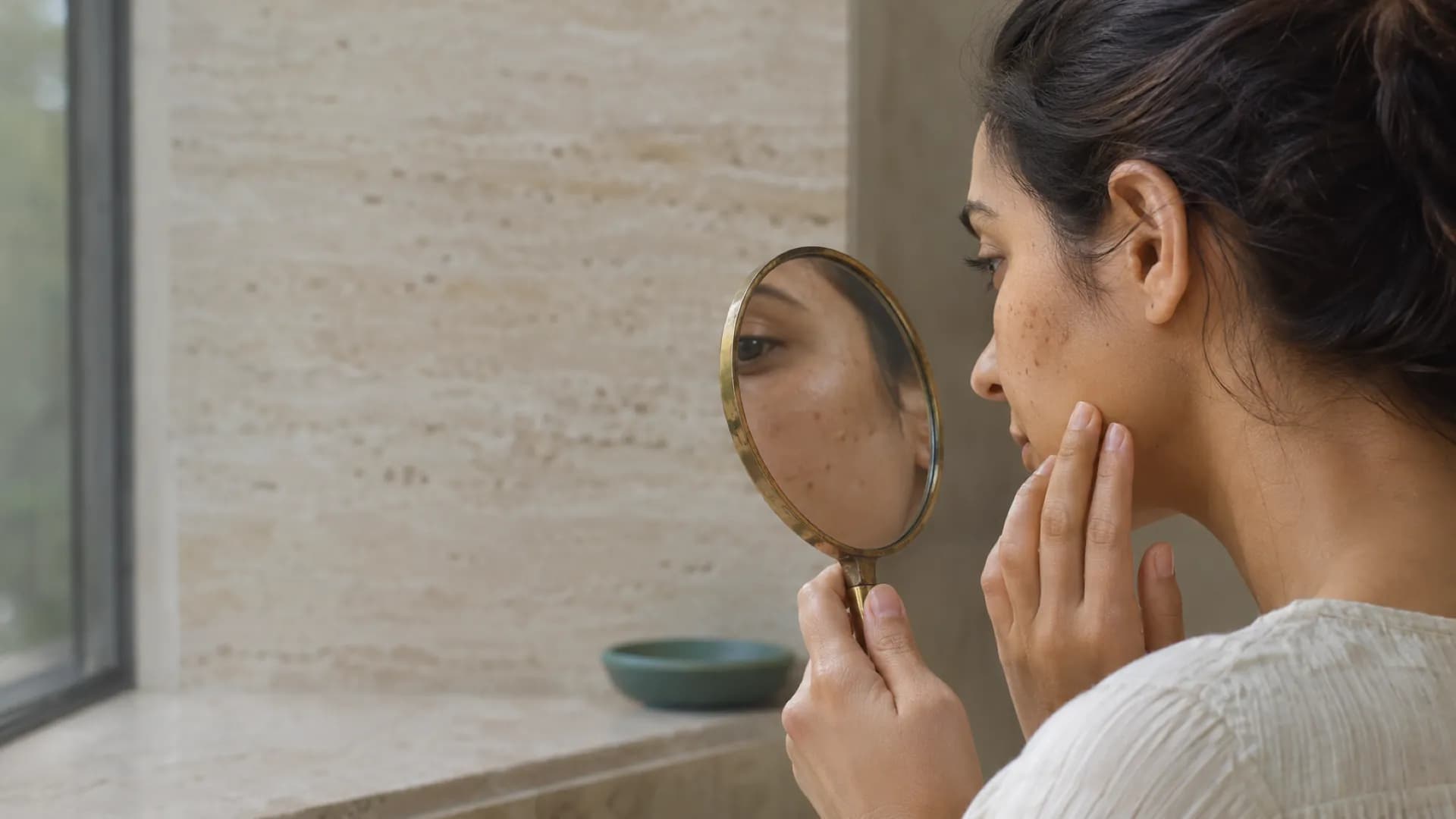
Dark Spots on Face: Causes, Types and What Helps
How to tell sun spots, marks left by acne and melasma apart, why depth in the skin matters, and what a doctor may suggest.
Article
Pimple Treatment: Options, What Works, and When to See a Doctor
What helps active acne, what does not, which medicines are a doctor's decision and how to avoid scars. For marks and dips that remain, see acne scar treatment.

Control is the aim, so start with a clear diagnosis.
A doctor looks at your skin and what is behind the concern, then writes a plan with the full price before you begin.
Choose skin care, a centre and a time
Two taps. Nothing is stored on the website.
Your message opens in WhatsApp
You send it yourself and can add anything for the doctor.
The team confirms your visit
Your doctor reviews your history before suggesting anything.
4.9 from 1,238 Google reviews(Delhi centre)Doctor-led since 2004