
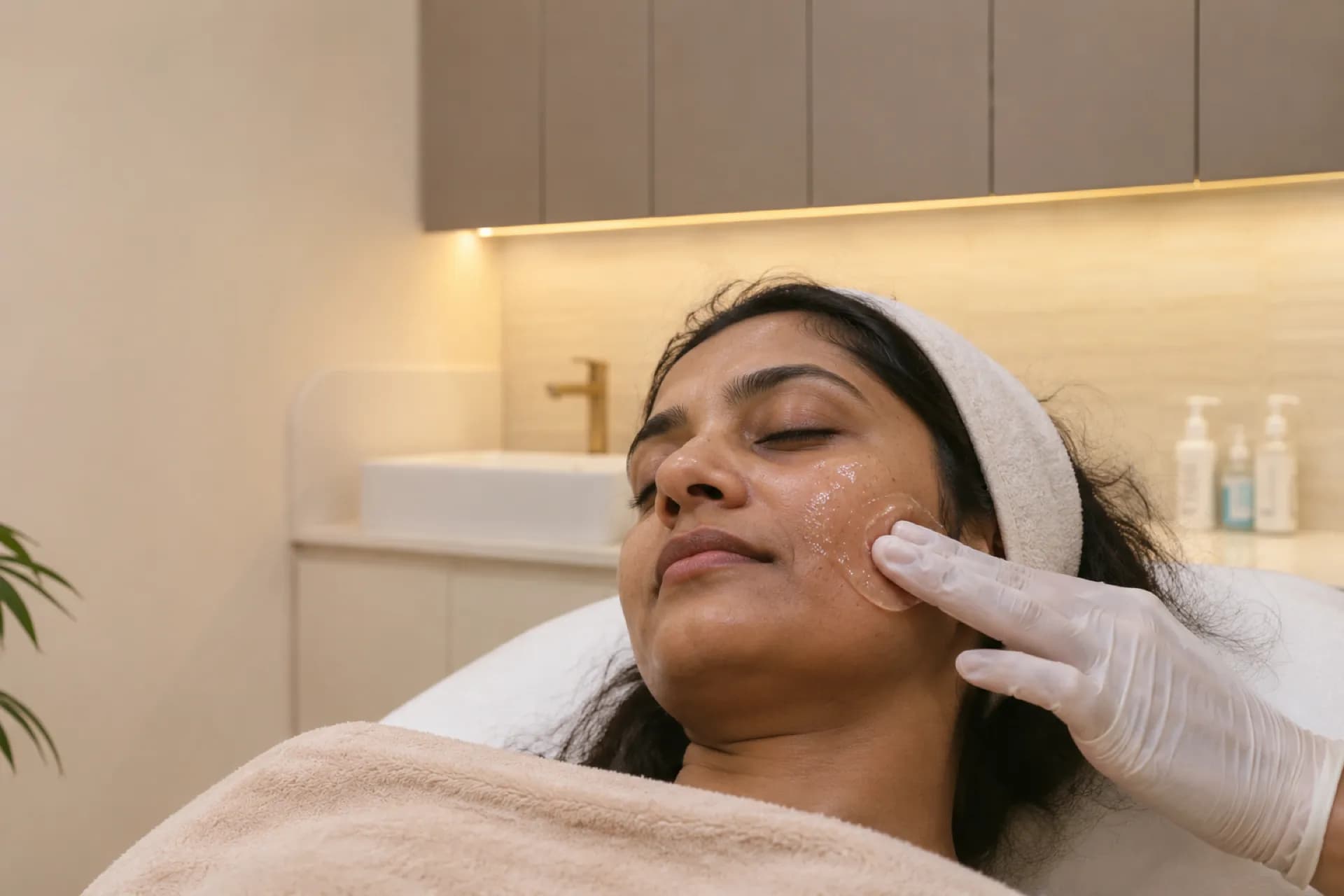
Hydrafacial: what a session does, and what it cannot do.
A Hydrafacial is a device-assisted facial that cleanses, exfoliates, extracts and hydrates in one visit. This page helps you decide and book. For the full pros and cons, read our Hydrafacial benefits guide.
Two taps, then WhatsApp. A doctor reviews your history before any treatment is suggested.
4.9 from 1,238 Google reviews(Delhi centre)Doctor-led since 2004
Hydrafacial Consultation at a glance
- Indicative price
- ₹5,000–₹12,000 per session
- Session length
- About 30 to 45 minutes
- Downtime
- Little to none
- Courses
- A series, then upkeep
- How long it lasts
- Temporary
- Works alongside
- Daily skin care
What these figures mean
- Indicative price
- Delhi NCR range. Add-ons and the number of sessions change the total.
- Session length
- Varies with the areas treated and any add-ons.
- Downtime
- Pinkness is common. Stronger settings caused redness for 2 to 5 days in one study.
- Courses
- Studies used 6 sessions, 1 to 2 weeks apart. Your doctor sets yours.
- How long it lasts
- Related resurfacing results fade without follow-up, says the AAD.
- Works alongside
- Sunscreen, a moisturiser and any medical treatment your doctor sets.
Indicative range in Delhi NCR. Your doctor confirms the plan and final price at consultation.Updated
The short answer
A Hydrafacial is a device-assisted facial that cleanses and exfoliates the skin, draws loosened debris out of pores with gentle suction, then applies serums, usually in about 30 to 45 minutes. Small studies report smoother skin with little downtime, but the effect is temporary and it does not treat scars, melasma or active acne flares. In Delhi NCR it usually costs about ₹5,000 to ₹12,000 a session.
Is a Hydrafacial right for your skin?
Often suits
- People with dull, rough-feeling or congested skin who want a surface treatment with little downtime.
- People with oily or blackhead-prone skin who want gentle extraction alongside a home routine a doctor sets.
- People who want to start gently: the intensity can be kept mild, and small studies included skin types II to V.
- Anyone planning ahead for an event who accepts that the effect is temporary.
May not suit
- An active, inflamed acne flare, or deep cystic acne, which needs medical treatment first.
- A rosacea flare, sunburnt or very reactive skin, open sores or an active cold sore.
- Recent peels, lasers or isotretinoin. Your doctor decides the timing, because advice on procedures after isotretinoin differs between guidelines.
3 more reasons
- Pregnancy or breastfeeding, when a doctor decides and many in-clinic skin treatments are deferred.
- Acne scars, melasma or deeper wrinkles, which need their own treatment plan.
- Anyone expecting a lasting change in skin tone or texture from one session.
How a Hydrafacial works, step by step
Hydrafacial is the trade name of a device-assisted facial made by a third-party company; research papers call the technique hydradermabrasion. A handpiece with a swirl-patterned tip is passed over the face in stages. First the skin is cleansed and a mild acid-based solution loosens the top layer of dead cells. Gentle suction then draws loosened oil and debris out of the pores. Serums, usually antioxidant or hydrating, are applied during or after, and the visit finishes with sun protection. The intensity can be adjusted: in one imaging study a mild setting left no visible redness, while a stronger one caused redness for a few days. That is why a doctor looks at your skin first and sets the level. It is a surface treatment. It works on the outer layers and the contents of pores, not on scars, deep wrinkles or pigment that sits deeper in the skin.
Cleanse
Lifts oil, make-up and surface debris.
At the pore: the plug is untouched.
Exfoliate
A mild acid-based solution loosens the top layer of dead cells.
At the pore: the plug begins to loosen.
Extract
Gentle suction draws loosened debris out of the pore.
At the pore: the plug is drawn upward and out.
Hydrate and protect
Serums go on, then sun protection.
At the pore: it is clear, and the surface holds water.
Order, timing and solutions vary by device and protocol. Your doctor sets yours.
Sources: Freedman, Journal of Cosmetic Dermatology, 2008; Razi et al., Skin Research and Technology, 2024
How care runs at Clinic Eximus
The same order for everyone, so nothing is decided before the cause is clear.
Step 1
Skin check and history
Your doctor looks at your skin type, any active acne, rosacea or sensitivity, recent treatments and medicines, and whether you are pregnant or breastfeeding. This decides whether a Hydrafacial suits you and at what intensity.
Step 2
Cleanse and exfoliate
The skin is cleansed and a mild acid-based solution loosens the top layer of dead cells and the plugs sitting in pores.
Step 3
Extract and hydrate
Gentle suction draws the loosened oil and debris out of the pores, and hydrating or antioxidant serums are applied.
Step 4
Protect and plan
Sun protection goes on. You leave with aftercare guidance and, if it suits you, a plan for how often to repeat and what to use at home.
What the research says
Published studies and guidelines, linked so you can read them yourself. Evidence is not a promise for any one person.
20 women · 6 sessions. In a randomised study of 20 women aged 34 to 56, six hydradermabrasion sessions 7 to 10 days apart thickened the upper skin layers and raised antioxidant levels in the skin. Fine lines, pore size and pigmentation decreased, with no complications reported. The same serum rubbed on by hand changed nothing. It was small and short, and tested one device and serum. (Freedman, Hydradermabrasion: an innovative modality for nonablative facial rejuvenation, Journal of Cosmetic Dermatology (PubMed 19146604), 2008) opens in a new tab
8 people · skin types II–V. In 8 volunteers with skin types II to V, imaging showed the outer skin layer thinner straight after treatment (9.4 to 6.7 micrometres) and back to baseline, slightly thicker, at 2 weeks. Stronger settings caused redness that settled within 2 to 5 days. No breakouts, irritation or dark marks were reported. (Razi et al., Hydradermabrasion through the lens of line-field confocal optical coherence tomography, Skin Research and Technology (PMC10983707), 2024) opens in a new tab
20 people · 12 weeks. In 20 adults with mild to moderate acne, six treatments two weeks apart (cleansing and peeling, suction, then blue light) raised the share with clear or almost clear skin from 20% to 65% by investigator rating. It was open-label with no control group, and one author is employed by the device maker. (Storgard et al., HydraFacial Clarifying Treatment series in active acne vulgaris, Journal of Clinical and Aesthetic Dermatology (PMC9762628), 2022) opens in a new tab
2 more studies
5–16 sessions typical. For microdermabrasion, a related surface treatment, dermatologists say results tend to be temporary and most people need a series, often 5 to 16 treatments when the aim is ageing signs, with sun protection to keep results. (American Academy of Dermatology: microdermabrasion FAQs, 2026) opens in a new tab
Limited for pigment and acne. An evidence review of microdermabrasion found changes in skin structure and contour irregularities, but a limited role in pigmentation problems and acne. (Karimipour et al., Microdermabrasion: an evidence-based review, Plastic and Reconstructive Surgery (PubMed 20048628), 2010) opens in a new tab
We will tell you if Hydrafacial is not the right first step for you.
What to expect around a Hydrafacial
Typical milestones from published studies and guidelines. Your doctor sets your own schedule.
Day 0
Skin check, then about 30 to 45 minutes of treatment
Same day
Skin often feels smoother; pinkness is common
Days 1–5
Any redness settles; daily sunscreen from day one
Weeks 1–2
The surface effect fades; a planned course continues
Month 3
Review a finished course against your first photos
What to expect
- Skin often looks and feels smoother straight afterwards. That is a surface effect, and it fades over days to weeks.
- Small studies report changes after a series of sessions, not one visit. They were small and short, and none compared a Hydrafacial with an ordinary facial.
- A Hydrafacial does not treat acne scars, melasma or deeper wrinkles, and it does not replace medical treatment of active acne or rosacea.
- Pores can look cleaner for a while after extraction, but they cannot be closed and they refill if oil production continues.
- Daily sunscreen and a simple routine matter more to how long results last than any single session.
Side effects and safety
- Pinkness for a few hours to a day is common. In one imaging study a mild setting caused no visible redness, and stronger settings caused redness that settled within 2 to 5 days.
- Stinging, tingling or dryness can occur. In a 2022 acne series they were most frequent after the first treatment and less so after the last.
- Indian skin (Fitzpatrick III to V) is more prone to dark marks after irritation. Tell your doctor if your skin marks easily, and use sunscreen every day afterwards.
- Tell your doctor before booking if you have active acne, rosacea, are pregnant or breastfeeding, or have recently used isotretinoin, peels or lasers.
- Contact the clinic if redness spreads or lasts, or if you develop blisters or a rash.
Hydrafacial price in Delhi NCR
₹5,000–₹12,000
per session
Indicative range in Delhi NCR. Your doctor confirms the plan and final price at consultation.
What changes the cost
- How many sessions are in your plan, and whether upkeep sessions are suggested.
- The areas treated and any add-ons chosen with your doctor.
- Whether the Hydrafacial sits alongside another in-clinic treatment in the same plan.
- Home products and sunscreen, which are a separate cost.
Questions people ask
What is the price of a Hydrafacial in Delhi?
Across Delhi NCR, a Hydrafacial usually costs about ₹5,000 to ₹12,000 per session. Your total depends on the add-ons you choose, how many sessions are in your plan and whether upkeep visits are suggested. Your doctor confirms the plan and final price in writing at consultation, before you commit to anything.
How long do Hydrafacial results last?
The surface effect is temporary. In an imaging study the outer skin layer had returned to its starting thickness within 2 weeks, and dermatologists describe results of the related microdermabrasion as temporary too. How long skin stays smooth depends on your skin, sun protection and home routine. Your doctor can suggest a repeat schedule if it suits you.
How often should you get a Hydrafacial?
There is no single agreed schedule. Studies used a series of 6 sessions, 1 to 2 weeks apart, and upkeep is usually spaced further apart. Your doctor sets yours after seeing your skin, and may suggest fewer sessions if your skin is sensitive. More frequent is not better: irritated skin can look worse, not brighter.
Is a Hydrafacial good for acne?
It can help mild to moderate acne alongside medical care, but it is not a treatment on its own. A small 2022 study of 20 adults saw clearer skin after six sessions, though it had no control group. Deep, inflamed or cystic acne needs medical treatment first, and a Hydrafacial may be paused during a flare. Your doctor will say which applies.
Does a Hydrafacial have side effects?
Mild ones are common: pinkness, stinging, tingling or dryness, usually settling within a day. Stronger settings caused redness for 2 to 5 days in one study. Rarely, skin that is reactive or marks easily can react more. Tell your doctor if you have rosacea, active acne or recent peels or lasers, and contact the clinic if redness spreads or you get blisters.
Can I have a Hydrafacial if I am pregnant?
A doctor decides. Evidence on cosmetic procedures in pregnancy and breastfeeding is thin, based mostly on case reports, and many clinics defer in-clinic skin treatments. If you are pregnant or breastfeeding, tell your doctor before booking. A gentle home routine with sunscreen is usually the starting point, and treatments can be planned for afterwards.
Is a Hydrafacial different from a normal salon facial?
It uses a device for cleansing, exfoliation and suction extraction, and here it follows a doctor's check of your skin. We found no trials comparing a Hydrafacial with an ordinary facial, so we cannot say it works better. The practical difference is assessment: your doctor can spot acne, rosacea or pigmentation that changes the plan.
Read next
Article
Hydrafacial Benefits and Disadvantages: What the Evidence Shows
What a Hydrafacial can and cannot do, how strong the evidence is, the side effects to expect and who should be cautious or wait.
Article
Which Facial Suits Your Skin? A Guide by Skin Concern
Dry, oily, acne-prone, dull or sensitive: what each skin type needs from a facial, what to be careful with, and when to see a doctor first.
Article
Pimple Treatment: Options, What Works, and When to See a Doctor
What helps active acne, what does not, which medicines are a doctor's decision and how to avoid scars. For marks and dips that remain, see acne scar treatment.
Find out if a Hydrafacial suits your skin.
A doctor looks at your skin and what is behind the concern, then writes a plan with the full price before you begin.
Choose skin care, a centre and a time
Two taps. Nothing is stored on the website.
Your message opens in WhatsApp
You send it yourself and can add anything for the doctor.
The team confirms your visit
Your doctor reviews your history before suggesting anything.
4.9 from 1,238 Google reviews(Delhi centre)Doctor-led since 2004