
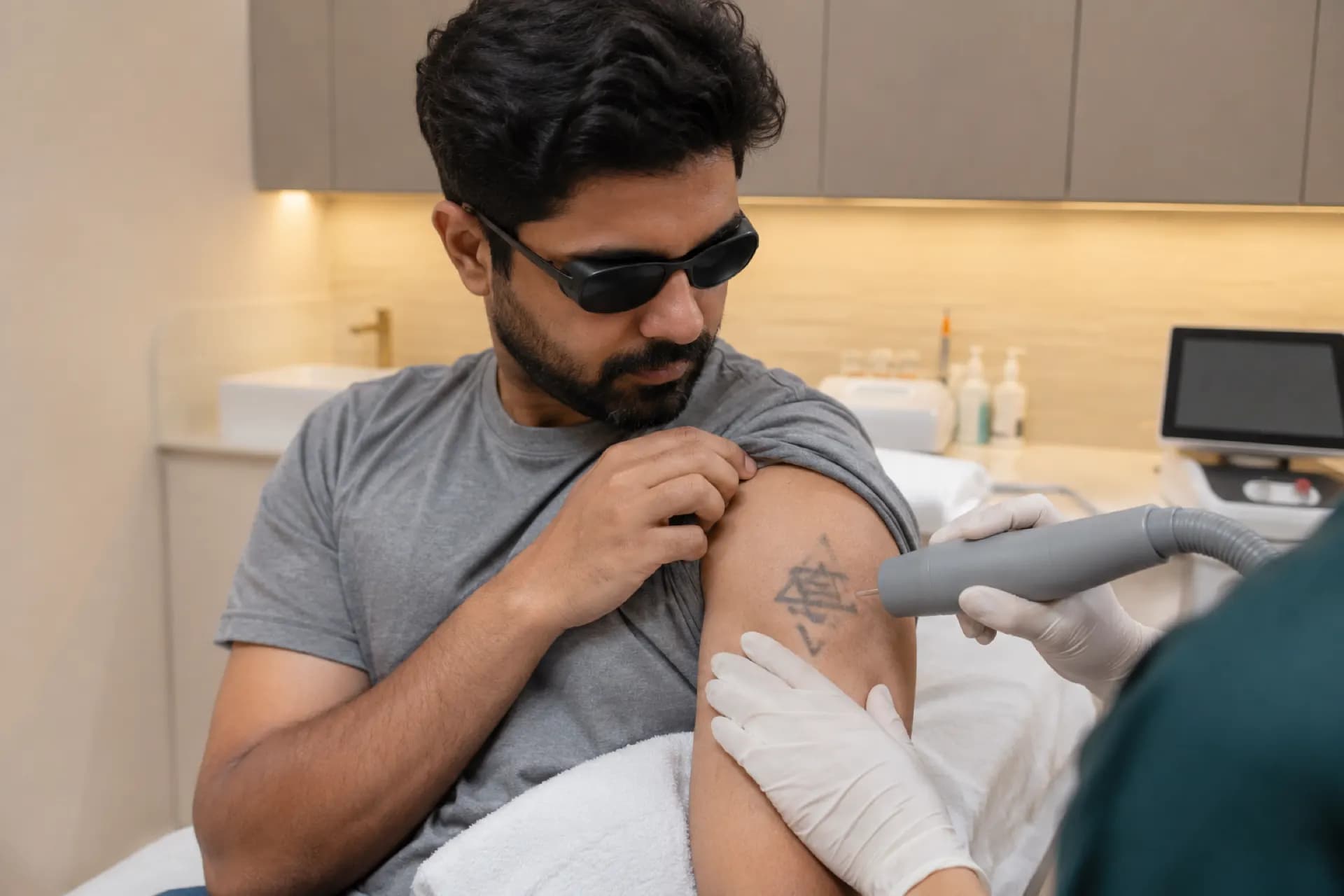
Laser tattoo removal: sessions, cost and what can stay behind.
Lasers break tattoo ink into smaller pieces that the body clears over weeks, so removal takes many sessions. Black ink fades most readily; some ink may stay, and brown skin can mark.
Two taps, then WhatsApp. A doctor reviews your history before any treatment is suggested.
4.9 from 1,238 Google reviews(Delhi centre)Doctor-led since 2004
Laser Tattoo Removal at a glance
- Indicative price
- ₹2,000–₹10,000 per session
- Sessions
- Often 5 to 10 or more
- Gap between sessions
- About 6 to 8 weeks or longer
- Downtime
- A few days of redness or swelling
- First step
- Assessment and a test spot
- When to judge results
- After the course, not each session
What these figures mean
- Indicative price
- Delhi NCR range for small to medium tattoos. Large or coloured tattoos cost more, and a course needs many sessions.
- Sessions
- A 2026 review found 4 to 8 sessions to reach about 75% clearance. Indian guidance cites 5 to 20.
- Gap between sessions
- The body needs time to clear fragments. Your doctor sets the gap.
- Downtime
- A blister or scab is possible. Keep the area clean and out of the sun.
- First step
- The doctor checks ink colour, age, depth, location and your skin before treatment.
- When to judge results
- Ink keeps fading for weeks between visits. Some tattoos never clear fully.
Indicative range in Delhi NCR. Your doctor confirms the plan and final price at consultation.Updated
The short answer
Laser tattoo removal uses very short pulses of light that ink absorbs, shattering it into fragments that the body's immune cells carry away over the following weeks. Most tattoos need many sessions spaced weeks apart, black fades most readily, and some ink may not clear fully. On Indian skin (Fitzpatrick types III to V) the main risks are lighter or darker patches and, less often, scarring, so a doctor assesses the tattoo and your skin first.
Is laser tattoo removal right for your tattoo and skin?
Often suits
- People with black or dark-blue tattoos, which respond most readily, including older, faded and amateur tattoos.
- People who want a tattoo lightened so it can be covered or reworked, or removed, and who accept that it takes many sessions over many months.
- People who can keep the area out of strong sun, avoid tanning and come back every 6 to 8 weeks or so.
- People who prefer a doctor to assess the tattoo, their skin type and any scarring tendency before the first pulse.
May not suit
- Tattoos in several colours, especially green, light blue, yellow and white. They absorb fewer wavelengths, respond less predictably and white or skin-tone ink can darken.
- A tattoo that is still healing, an infection or open skin in the area, or a recent tan or sunburn. Treatment is postponed until the skin is ready.
- Pregnancy. Treatment is usually deferred, and a doctor decides about breastfeeding.
3 more reasons
- A history of thick keloid scars, vitiligo, or medicines that make skin sensitive to light. Your doctor reviews each of these first.
- Cosmetic tattoos near the eyes, such as eyeliner or eyebrow pigment. They need specific care and are discussed carefully before anything is offered.
- Anyone expecting completely clear skin. Some ink, a faint shadow, a change in colour or texture may remain.
How laser breaks up tattoo ink, and why it takes so many sessions
Tattoo ink is held in the dermis by immune cells, in particles too large to clear. A laser pulse short enough, in nanoseconds (Q-switched) or picoseconds, is absorbed by the ink and shatters it into fragments before much heat spreads. Immune cells carry the fragments away over weeks, so fading continues after each session and a further session is spaced weeks later. Black absorbs most wavelengths, so it clears most readily; other colours absorb only some, so they need particular wavelengths and respond less predictably. Brown skin holds more pigment, which competes for the same light. The 1064 nm Nd:YAG wavelength is the one most often studied in darker skin, and your doctor chooses the device and settings.
1BeforeInk sits in the dermis
Tattoo ink is placed below the top layer, as particles too large for the body to clear. Immune cells have swallowed it and hold it in place, which is why a tattoo lasts.
2The pulseA very short flash of light
Ink absorbs the light. The pulse is short enough, nanoseconds or picoseconds, to shatter each clump into fine fragments before much heat spreads to the skin around it.
3Weeks laterThe body clears fragments
Immune cells carry the small fragments away through the lymph vessels over weeks. Some ink remains, so a further session is timed once the skin has settled. Ink that stays can look pale or shadowy.
Why the colour of the ink matters
- Black and dark blueAbsorb most laser wavelengths, so they usually clear most readily.
- Green, light blue, yellowAbsorb only some wavelengths, so they respond more slowly and less predictably.
- White and some skin-tone inksCan darken after a pulse, which a doctor tests for first.
Drawings are simplified. Real tattoos vary in depth and density, and brown skin holds more pigment of its own, so a doctor chooses the device and settings and tests a small area first. General guidance, not a promise of clearance.
How care runs at Clinic Eximus
The same order for everyone, so nothing is decided before the cause is clear.
Step 1
Assessment and test spot
Your doctor looks at ink colours, age, depth, location, scarring tendency and your skin type, then treats a small test spot. A test spot cannot rule out every reaction, but it is a sensible check on brown skin.
Step 2
Treatment session
Eye protection is worn, the skin is cooled, and short pulses are delivered over the tattoo. It can feel like a sharp snap, and numbing or cooling is used if your doctor advises.
Step 3
Healing and aftercare
Expect redness, swelling and sometimes a blister or scab. Keep the area clean, do not pick, and protect it from the sun, exactly as your doctor instructs.
Step 4
Waiting between sessions
Fragments are cleared over weeks, so sessions are spaced about 6 to 8 weeks or longer. Closer gaps are not faster and may raise the risk of marks.
Step 5
Review and decide when to stop
After each session your doctor reviews fading and skin. Some people stop at a faded tattoo, and some continue; leftover ink is discussed honestly.
What the research says
Published studies and guidelines, linked so you can read them yourself. Evidence is not a promise for any one person.
36 studies · colour harder than black. A systematic review of 36 studies, 7 of them randomised trials, found Q-switched Nd:YAG and picosecond lasers both safe and effective for black tattoos. Picosecond lasers showed better clearance of blue, green and yellow ink. (Comparing the efficacy and safety of laser treatments in tattoo removal: a systematic review, Journal of the American Academy of Dermatology, 2020) opens in a new tab
352 people · median 10 sessions. In a cohort of 352 people treated in Milan with Q-switched lasers, the median was 10 sessions. Clearance was 47.2% after 10 sessions and 74.8% after 15. No side effect other than short-lived change was seen in 93.8%. Darkening occurred in 4.8% (all coloured tattoos, more with white ink) and lasting lighter patches in 2.3%. Smoking, large, old, coloured and leg or foot tattoos cleared less. (Removal of tattoos by Q-switched laser: variables influencing outcome and sequelae in a large cohort of treated patients, Archives of Dermatology (JAMA Dermatology), 2012) opens in a new tab
Indian guideline · 5 to 20 sessions. Indian dermatology guidelines say 5 to 20 sessions are commonly cited for lightening tattoos, that professional tattoos need more treatment, and that amateur tattoos often respond better. They advise that complete clearance cannot be promised. (Standard guidelines of care: lasers for tattoos and pigmented lesions, Indian Journal of Dermatology, Venereology and Leprology, 2009) opens in a new tab
5 more studies
46 studies · low to moderate certainty. A 2026 systematic review of 46 Nd:YAG studies, mostly of skin types III to V, found meaningful clearance of black and blue ink, with 4 to 8 sessions typically needed to reach about 75% clearance. Amateur tattoos cleared faster, coloured ink less and less predictably, and the certainty of the evidence was low to moderate. (Efficacy of Nd:YAG lasers for tattoo removal: systematic review of clinical outcomes, clearance rates and treatment parameters, Journal of Cosmetic Dermatology (PMC13276302), 2026) opens in a new tab
130 people · picosecond vs Q-switched. In a single-hospital review of 130 people, 78.1% of tattoos treated with a picosecond 1064 nm laser reached excellent clearance (76 to 100%) against 54.4% with a Q-switched 1064 nm laser. Overall clearance above 50% was similar once adjusted (94.5% against 86.0%). It is retrospective, from one centre. (Q-switched 1064-nm laser versus picosecond 1064-nm laser in tattoo removal, Journal of Cosmetic Dermatology (PMC13428261), 2026) opens in a new tab
94 practitioners · 8.1% of sessions. A survey of 94 practitioners who perform laser tattoo removal estimated complications in 8.1% of sessions: swelling 3.0%, blistering 1.9%, lighter patches 0.6%, darker patches 0.5% and raised scars 0.2%. Skin types III to VI and coloured ink carried higher risk, and clients previously treated by untrained operators often had problems. It is reported by practitioners, not measured in a trial. (Practitioner-reported complications in tattoo removal, Dermatology (PMC13278705), 2026) opens in a new tab
Types V–VI · half had darkening. DermNet NZ notes that skin of colour is under-studied for lasers. In one study of tattoo removal in skin types V to VI with a Q-switched Nd:YAG laser, about half developed mild darkening lasting 2 to 4 months. The evidence is small and mixed. (Laser therapy in skin of colour, DermNet NZ, 2023) opens in a new tab
Mouse study · ink held by macrophages. In mice, tattoo ink was held by macrophages in the dermis, and ink persisted because new macrophages re-took it up rather than because individual cells lived long. This helps explain why a tattoo is stable, and why clearing it is slow and repeated. It is an animal study. (Unveiling skin macrophage dynamics explains both tattoo persistence and strenuous removal, Journal of Experimental Medicine (PMC5881467), 2018) opens in a new tab
We will tell you if laser tattoo removal is not the right first step for you.
From the test spot to the last session
Typical milestones from published studies and guidelines. Your doctor sets your own schedule.
Before
Assessment of ink and skin; a test spot is treated
Session
Short pulses over the tattoo; cooling and eye protection
The next days
Redness and swelling; a scab or blister is possible
Over 6 to 8 weeks
Ink keeps fading as the body clears fragments
Each review
Continue, change settings or stop, as you and your doctor decide
What to expect
- Removal takes many sessions over many months. Black fades most readily, and coloured ink, large and older professional tattoos take longer.
- Some tattoos do not clear fully. A faint shadow, a pale or darker patch or a texture change can remain, and it may be lasting.
- Amateur tattoos often clear faster than professional ones, but results still vary person to person.
- Cost per session is not the cost of the course. Ask for an estimate of sessions and what happens if you need more.
- Cream, salt or home devices are not substitutes. Untrained treatment is linked to burns and scars in reports from practitioners.
Side effects and safety
- Redness, swelling, tenderness and a scab or blister are common and usually settle over days to a couple of weeks. A doctor advises on care.
- Indian skin can develop darker or lighter patches after laser. Most darkening settles over months, but pale patches can last, so settings, spacing and sun protection matter.
- White and some coloured inks can darken after a pulse, so a test spot comes first.
- Less often there is infection, raised or pitted scarring, or keloid. Tell your doctor if you have ever had keloid scars.
- Contact the clinic promptly for spreading redness, pus, fever, severe pain or a wound that is not healing.
Laser tattoo removal cost in Delhi: per session and per course
₹2,000–₹10,000
per session, small to medium tattoo
Indicative range in Delhi NCR. Your doctor confirms the plan and final price at consultation.
What changes the cost
- The size of the tattoo: a one-inch design costs far less than a sleeve or back piece.
- The colours, density and age of the ink, which decide how many sessions are likely.
- The device, such as Q-switched or picosecond, and the number of sessions, which is the biggest factor in the total.
- Whether you pay per session or for a package. Ask what a package includes, what happens if you need extra sessions and whether the test spot is charged.
Questions people ask
How much does laser tattoo removal cost in Delhi?
Delhi NCR clinics commonly publish about ₹2,000 to ₹10,000 per session for small to medium tattoos, rising for large or coloured ones. The range is indicative and not a quote. Because you need many sessions, compare the cost of the whole course. Clinic Eximus confirms size, number of sessions and price in writing after your consultation.
How many sessions of laser tattoo removal will I need?
Usually many. A 2026 review found 4 to 8 sessions to reach about 75% clearance, and Indian guidance cites 5 to 20. A Milan cohort needed a median of 10. Black, amateur and small tattoos need fewer; coloured, large, old and leg tattoos need more. Your doctor gives a range after assessing the tattoo.
Does laser tattoo removal hurt?
Most people describe a sharp snapping or stinging feeling during each pulse, which lasts only during treatment. It varies by person, tattoo and area, and thin skin over bone is often more sensitive. Cooling or numbing cream may be used if your doctor advises. Ask what to expect before you start.
Can a tattoo be fully removed with laser?
Not always, and no clinic should promise it. Many tattoos fade a great deal, but some ink or a faint shadow can stay, and coloured ink clears less predictably. In a Milan cohort, cumulative clearance was 74.8% after 15 sessions. Smoking, size, age and colour all matter.
Which tattoo colours are hardest to remove?
Green, light blue, yellow and white are usually harder than black and dark blue. Black absorbs most laser wavelengths, while other colours absorb only some, so they need particular wavelengths. White and skin-tone inks can also darken after a pulse. Picosecond lasers cleared blue, green and yellow better in a systematic review.
Does laser tattoo removal cause scars on Indian skin?
Scarring is uncommon but possible, and darker or lighter patches are likelier on brown skin. A practitioner survey reported raised scars in 0.2% of sessions and lighter patches in 0.6%, with higher risk in skin types III to VI. Test spots, careful settings, proper spacing and sun protection lower the risk.
What aftercare does laser tattoo removal need?
Keep the area clean, do not pick scabs or burst blisters, and protect it from the sun with clothing or sunscreen, as your doctor advises. Use any prescribed ointment, avoid friction and hot water on the spot for a short time, and report spreading redness, pus or fever to the clinic quickly.
Why is my tattoo not fading?
Common reasons are the ink colour, a dense or deep professional tattoo, a leg or foot location, smoking, sessions spaced too close, or a laser not matched to the ink. A Milan cohort linked these to poorer clearance. Fading also continues for weeks after each session, so judge it before the next.
Is a picosecond laser better than Q-switched for tattoos?
Picosecond lasers cleared blue, green and yellow ink better in a systematic review and gave more excellent clearance in a 2026 single-centre review, though overall clearance was similar after adjustment. Both work for black ink. Device matters less than matching settings to your skin and ink, so your doctor chooses.
Read next
Article
Dark Spots on Face: Causes, Types and What Helps
How to tell sun spots, marks left by acne and melasma apart, why depth in the skin matters, and what a doctor may suggest.

Article
Is Laser Lip Treatment Safe for Indian Skin?
Laser lip treatment is usually well tolerated in small studies, but cold sores, patchy colour and darkening on Indian skin are real risks. Who should wait.

Plan for many sessions, and for what may stay.
A doctor looks at your skin and your goals, then writes a plan with the full price before you begin.
Choose aesthetic care, a centre and a time
Two taps. Nothing is stored on the website.
Your message opens in WhatsApp
You send it yourself and can add anything for the doctor.
The team confirms your visit
Your doctor reviews your history before suggesting anything.
4.9 from 1,238 Google reviews(Delhi centre)Doctor-led since 2004