
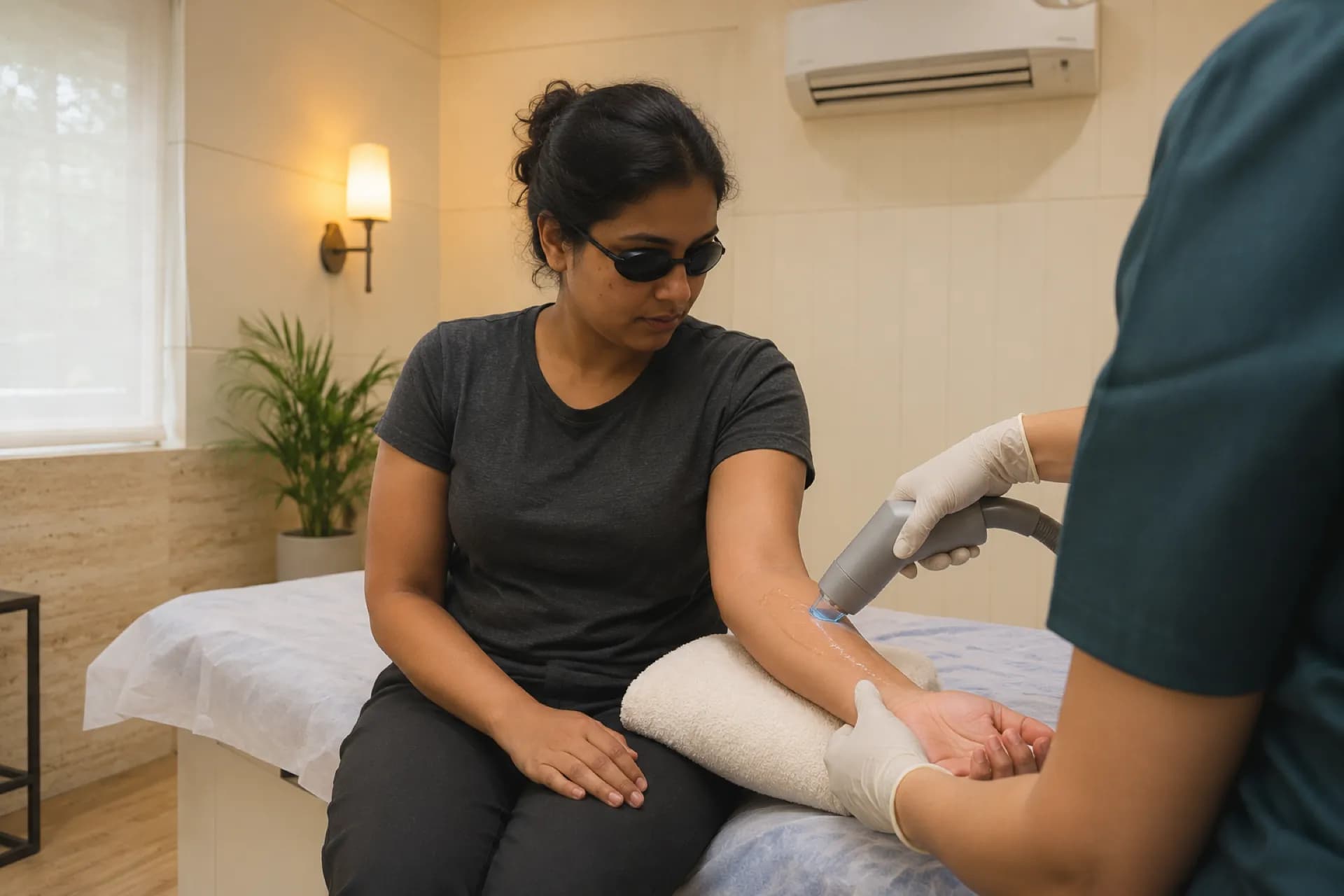
Laser hair removal reduces hair for years, not forever. Here is how to plan for it.
Lasers reduce hair for the long term; they do not remove it for good. A doctor checks your skin type, hair and hormones, tests a small patch, then spaces the sessions to match how hair grows.
Two taps, then WhatsApp. A doctor reviews your history before any treatment is suggested.
4.9 from 1,238 Google reviews(Delhi centre)Doctor-led since 2004
Laser Hair Removal at a glance
- Price
- ₹14,999 per full-body session
- Sessions
- Usually 4 to 6 or more
- Gap between sessions
- Often 4 to 6 weeks
- Downtime
- Redness for 1 to 3 days
- First step
- A small test patch
- When to judge results
- 6 to 12 months after the course
What these figures mean
- Price
- Clinic Eximus price. Face or bikini is ₹2,499 per session. A course needs several sessions.
- Sessions
- Studies used 4 to 6. The face, fine hair and hormonal causes such as PCOS often need more.
- Gap between sessions
- Timed to the hair growth cycle and the body area. Your doctor sets it.
- Downtime
- Like mild sunburn. Sun avoidance matters before and after.
- First step
- Checks how your skin responds before the full area is treated.
- When to judge results
- Studies measure hair reduction at 6 and 12 months. Maintenance sessions may follow.
Clinic Eximus price. Your doctor confirms the plan and final price at consultation.Updated
The short answer
Laser hair removal uses light that dark hair absorbs, which damages the follicle so hair grows back finer and sparser. It reduces hair for the long term and does not remove it for good. On Indian skin (Fitzpatrick types III to V) the doctor chooses the device and settings carefully, tests a small patch first and spaces sessions several weeks apart, because only hair in its growth phase responds.
Is laser hair removal right for your skin and hair?
Often suits
- People with dark, thick hair on the face, underarms, bikini line, arms, legs or the whole body, who want fewer hairs and less shaving or waxing, and accept that it is a course of sessions.
- Men and women alike. Men commonly treat the back, shoulders, chest, neckline and beard edges, and the assessment is the same.
- People who can keep out of strong sun and avoid tanning before and between sessions, and who can come back every few weeks.
- People with PCOS or another hormonal cause of extra hair, when the cause is being checked or treated alongside, and who expect that more sessions may be needed.
May not suit
- White, grey and very light blonde or red hair. It has little pigment for the laser to absorb, and it tends to respond poorly or only for a short time.
- Fine, pale peach-fuzz hair, for example on the upper lip or cheeks, which often responds poorly even with many sessions.
- Recently tanned or sunburnt skin, or skin about to spend time in strong sun. Treatment is usually postponed until the tan fades, because tanned skin raises the risk of burns and dark marks.
3 more reasons
- Pregnancy. Treatment is usually deferred, and a doctor decides about breastfeeding. Tell the clinic if you are or might be pregnant.
- A cold sore or infection in the area, open skin, a history of thick keloid scars, or medicines that make skin sensitive to light. Your doctor reviews each of these first.
- Sudden, rapid or heavy hair growth, especially with irregular periods, acne or weight change. It needs a medical check for a hormonal cause before any hair removal.
Laser hair reduction: how the device and sessions are chosen
Laser hair removal relies on melanin, the pigment that colours hair. A pulse of light is absorbed by dark hair, and the heat damages the follicle around it. Brown skin holds more melanin too, so the surface can heat as well as the root. That is why device, wavelength, pulse length and cooling matter most on Indian skin. Longer wavelengths, such as Nd:YAG (about 1064 nm) and diode (about 800 nm), are the choices usually considered, and your doctor decides which at consultation. Only hair in its growth phase responds, and at any moment that is just part of the hair in an area. Sessions are therefore spaced weeks apart so more hair enters growth. White, grey and fine pale hair respond poorly, and hormones that keep switching on new hair can bring regrowth.
How care runs at Clinic Eximus
The same order for everyone, so nothing is decided before the cause is clear.
Step 1
Skin and hair assessment
Your doctor looks at your skin type, hair colour and thickness, recent sun, medicines, cold sores or keloid scarring, and any sign of a hormonal cause. Tests are suggested where a cause is suspected.
Step 2
Test patch
A small area is treated first, and your skin's response guides the device and settings. A patch cannot rule out every reaction, but it is a sensible check on brown skin.
Step 3
Sessions spaced by growth cycle
Each session treats the hair that is growing at that moment. Gaps of about 4 to 6 weeks let more hair enter growth, and your doctor adjusts them by body area and response.
Step 4
Care between sessions
Shave as instructed, and do not wax, pluck or thread the area. Protect treated skin from the sun, and report blisters, crusting or darkening early.
Step 5
Review and maintenance
After the course your doctor reviews what has changed. Hair that returns is often finer, and a few maintenance sessions may be advised for some people.
What the research says
Published studies and guidelines, linked so you can read them yourself. Evidence is not a promise for any one person.
11 trials · 444 people. A Cochrane review of 11 randomised trials with 444 people found about a 50% reduction in hair counts up to 6 months after treatment with alexandrite and diode lasers, and little evidence of benefit from IPL, Nd:YAG or ruby lasers in those trials. Long-term hair removal was not documented, and none of the trials was of high quality. It is an old review, and later studies in darker skin follow. (Laser and photoepilation for unwanted hair growth, Cochrane Database of Systematic Reviews (PubMed 17054211), 2006) opens in a new tab
Indian guideline: long-term reduction. Indian dermatology guidelines say the phrase long-term hair reduction should be used, not permanent hair removal. They state that multiple sessions are usually needed, that maintenance treatments may be needed later, and that underlying causes of hair growth should be investigated before treatment. (Standard guidelines of care: laser and IPL hair reduction, Indian Journal of Dermatology, Venereology and Leprology, 2008) opens in a new tab
12 trials · skin types III–VI. A meta-analysis of 12 comparative trials in skin types III to VI found long-pulsed Nd:YAG caused fewer post-inflammatory dark marks than IPL. Diode matched IPL on hair counts and safety, alexandrite reduced hair counts more than IPL, and lasers were more painful than IPL. (Lasers for reduction of unwanted hair in skin of colour: a systematic review and meta-analysis, JEADV (PubMed 31587390), 2020) opens in a new tab
6 more studies
200 women · skin types IV–V. A Delhi clinic study of 200 women with skin types IV and V used a long-pulsed Nd:YAG laser on the face for 6 sessions, with the gap lengthened from the second session. Six months later, more than 50% improvement was seen in 68.7% of lower-face, 89.7% of chin and 59% of upper-lip cases, and no one's hair growth worsened. (Long pulsed Nd:YAG laser with inbuilt cool sapphire tip for long term hair reduction on type IV and V skin: a prospective analysis of 200 patients, Indian Journal of Dermatology, Venereology and Leprology, 2010) opens in a new tab
29 people · 12 months. In 29 volunteers, lower-leg areas treated with a long-pulsed Nd:YAG laser at monthly intervals showed more than 50% hair loss in 44.9% of areas treated once, rising to 71.5% with up to five treatments. A year later it persisted in 40% of the five-treatment areas and in none of the single-treatment areas. (Hair removal with the long pulsed Nd:YAG laser: a prospective study with one year follow-up, Lasers in Surgery and Medicine (PubMed 11870792), 2002) opens in a new tab
16,900 patients · 0.69% complications. At a large dermatology centre, 16,900 people were treated and 0.69% had a complication. Bruise-type marks were the most common, then pigment changes. Risk was higher on the face and neck, with the alexandrite laser, and at higher alexandrite settings, in people of skin types III to IV. (Laser hair removal complications and the associated risk factors at a tertiary dermatology center: a case-control study, Lasers in Medical Science (PubMed 39145871), 2024) opens in a new tab
9,733 patients · about 3%. A pooled analysis of 9,733 people found paradoxical hypertrichosis, meaning new or thicker hair in the treated area, in about 3%. It was linked to the face and neck, and occurred in about 0.08% elsewhere. In three of four studies that followed it up, it improved with continued treatment. (Paradoxical hypertrichosis associated with laser and light therapy for hair removal: a systematic review and meta-analysis, American Journal of Clinical Dermatology (PubMed 34057666), 2021) opens in a new tab
Hormones can slow results. An Indian review notes that PCOS, thyroid disease, adrenal conditions and raised prolactin can influence regrowth after laser, and that white and grey hair respond poorly. Most people with dark hair see hair growth delayed by 2 to 6 months after one session, and tests are advised first where a hormonal cause is suspected. (Methods to overcome poor responses and challenges of laser hair removal in dark skin, Indian Journal of Dermatology, Venereology and Leprology (PubMed 30027915), 2019) opens in a new tab
88 women with PCOS · 5 sessions. In a randomised trial of 88 women with PCOS and facial hair, five high-setting laser treatments over 6 months cut self-rated facial hair severity from 7.3 to 3.6, against 7.1 to 6.1 with low settings. Time spent on hair removal fell from 112 to 21 minutes a week. The abstract does not report skin types. (A randomized controlled trial of laser treatment among hirsute women with polycystic ovary syndrome, British Journal of Dermatology (PubMed 15888157), 2005) opens in a new tab
We will tell you if laser hair removal is not the right first step for you.
From test patch to maintenance
Typical milestones from published studies and guidelines. Your doctor sets your own schedule.
Before
Skin and hair check; tests if a hormonal cause is suspected
Test patch
A small area is treated; settings follow your skin's response
Each session
Redness for 1 to 3 days; sun protection before and after
Every 4 to 6 weeks
Next session, timed to the hair growth cycle
After the course
Hair regrows finer and slower; maintenance only if needed
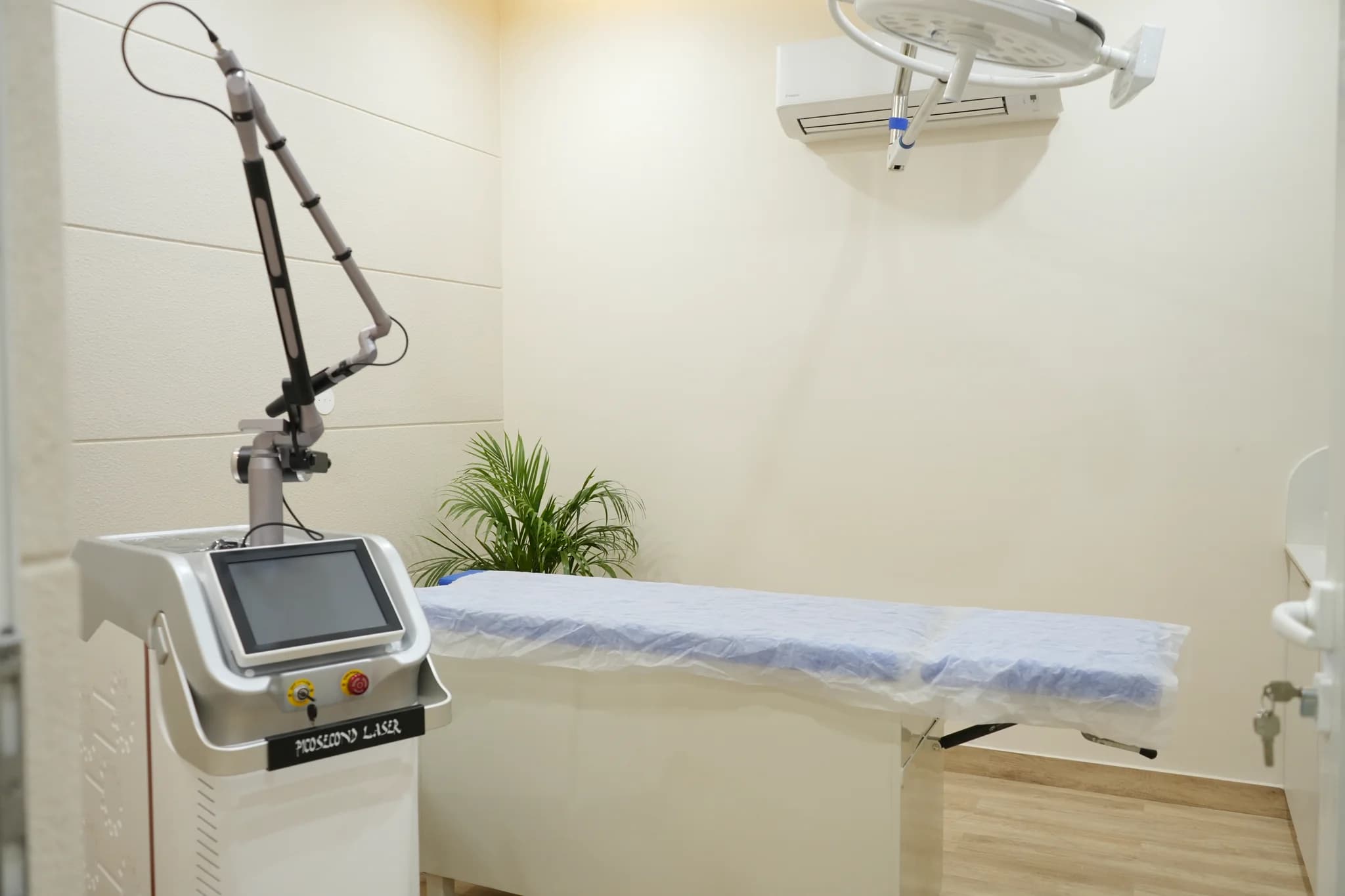
What to expect
- Laser reduces hair for the long term. It does not remove every hair, and regrowth, usually finer, is common. Some people need maintenance sessions.
- One session is not enough. In one study, none of the areas treated once still showed more than 50% reduction a year later.
- Results differ by area, hair and hormones. The face, fine hair and PCOS often need more sessions, and some hair may not respond at all.
- Hormonal causes keep switching on new hair, so checking and treating the cause is part of the plan, not an extra.
- Compare the cost of the whole course, not one session, and ask what happens if you need extra sessions.
Side effects and safety
- Redness, swelling and tenderness like mild sunburn are common and usually fade within 1 to 3 days. A cool compress helps.
- Brown skin is more prone to darker or lighter patches, blisters and burns if the device, settings or cooling are wrong, or if the skin is tanned. Most colour changes settle, but some can be lasting. This is why device choice and a test patch matter.
- About 3% of people notice new or thicker hair in the treated area, mostly on the face and neck. Tell your doctor, who will review it.
- Less often there are cold sore flare-ups, infection or scarring. Tell your doctor about cold sores, keloid scars and every medicine you use. Eye protection is worn for every session.
- Salon and home devices are not planned or supervised by a doctor, and burns and marks on brown skin are reported. Contact the clinic promptly for blisters, crusting, spreading pain or darkening that does not fade.
Laser hair removal cost in Delhi
₹14,999
per full-body session
Clinic Eximus price. Your doctor confirms the plan and final price at consultation.
What changes the cost
- The size and number of areas treated: underarms and upper lip cost far less than full legs or the full body.
- How many sessions you need, which depends on hair thickness, the area and any hormonal cause.
- The device and the experience of the clinician, and the test patch beforehand.
- Whether you pay per session or for a package. Ask what a package includes, what happens if you need extra sessions, and what maintenance would cost.
Questions people ask
How much does laser hair removal cost in Delhi?
At Clinic Eximus, laser hair reduction costs ₹14,999 per full-body session and ₹2,499 per session for the face or bikini. Other areas are quoted at consultation, and you need a course of sessions, so compare the cost of the whole course. Clinic Eximus confirms the areas, number of sessions and price in writing after your consultation.
Is laser hair removal permanent?
Not in the sense of every hair gone for good. Laser reduces hair for the long term: what returns is usually finer and sparser, and some people need maintenance sessions. A Cochrane review found about a 50% reduction up to six months but no documented long-term removal, and Indian guidelines ask clinicians to say long-term reduction rather than permanent removal. Hormones can bring regrowth.
How many sessions of laser hair removal do I need?
Studies have used about 4 to 6 sessions, and one found that a single session did not last: none of the areas treated once still showed over 50% reduction a year later. The face, fine hair and hormonal causes such as PCOS often need more. Your doctor estimates a range after assessing your hair and skin, and reviews it after each session.
Is laser hair removal safe for Indian skin?
It can be, when the device, settings and cooling suit your skin and a test patch comes first. Indian skin (Fitzpatrick types III to V) has more melanin, which competes with the hair for laser energy, so burns and dark or light marks are more likely if settings are wrong. In a pooled analysis, long-pulsed Nd:YAG caused fewer dark marks than IPL. Sun avoidance before and after matters.
What are the side effects of laser hair removal?
The commonest are redness, swelling and tenderness, like mild sunburn, usually for one to three days. Less often there are blisters, crusting, cold sore flare-ups, infection, scarring, and darker or lighter patches of skin, which are more likely on brown skin. About 3% of people notice new or thicker hair in the treated area, mostly on the face and neck. Tell your doctor early if a reaction worries you.
Does laser hair removal work for PCOS hair?
It can reduce facial hair in PCOS, but the underlying cause keeps driving growth, so progress is often slower and more sessions are needed. In a randomised trial of 88 women with PCOS, five treatments cut self-rated facial hair severity from 7.3 to 3.6 over six months. Doctors usually check hormones first and treat the cause alongside laser. Your doctor decides the plan.
Can I have laser hair removal while pregnant?
Treatment is usually deferred until after pregnancy, because there is too little safety evidence for cosmetic laser hair removal at this time. If you are pregnant, might be pregnant or are breastfeeding, tell your doctor, who decides what is suitable and when you can start or restart. Hair removal is rarely urgent, so waiting costs little.
Can I shave before laser hair removal, and what should I avoid?
Yes, usually. Guidelines describe trimming or shaving the area, often the day before, so only a few millimetres of hair remain. Do not wax, pluck or thread, because the laser needs the hair root in place, and avoid sunbathing and tanning. Come with clean skin, free of make-up and creams. Your clinic gives exact instructions, so follow those.
Can men have laser hair removal?
Yes. Men commonly treat the back, shoulders, chest, neckline and beard edges. The assessment is the same: skin type, hair thickness, hormones and sun exposure. A pooled analysis found new or thicker hair after laser mostly on the face and neck, so those areas are watched more closely. Dense or hormone-driven hair can need more sessions, and your doctor sets expectations.
Is laser or IPL better for brown skin?
A meta-analysis of 12 trials in skin types III to VI found long-pulsed Nd:YAG caused fewer dark marks than IPL, diode matched IPL for hair reduction and safety, and alexandrite reduced hair counts more than IPL, though lasers hurt more. Devices behave differently on brown skin, so your doctor matches the device to your skin rather than choosing one for everyone.
Read next

Article
Dark Underarms: Causes, Treatment and Home Remedies
Everyday causes, the signs of acanthosis nigricans that need a blood-sugar check, what has evidence behind it and a frank verdict on lemon and baking soda.

Article
Is Laser Lip Treatment Safe for Indian Skin?
Laser lip treatment is usually well tolerated in small studies, but cold sores, patchy colour and darkening on Indian skin are real risks. Who should wait.

Article
Dark Spots on Face: Causes, Types and What Helps
How to tell sun spots, marks left by acne and melasma apart, why depth in the skin matters, and what a doctor may suggest.

Start with a test patch, not a package.
A doctor looks at your skin and your goals, then writes a plan with the full price before you begin.
Choose aesthetic care, a centre and a time
Two taps. Nothing is stored on the website.
Your message opens in WhatsApp
You send it yourself and can add anything for the doctor.
The team confirms your visit
Your doctor reviews your history before suggesting anything.
4.9 from 1,238 Google reviews(Delhi centre)Doctor-led since 2004