
Birthmark removal starts with naming the birthmark.
A café-au-lait patch, a Mongolian spot, a port-wine stain and a mole are different things, so laser helps some and not others. A doctor identifies yours first, then says what can change and what cannot.
Two taps, then WhatsApp. A doctor reviews your history before any treatment is suggested.
4.9 from 1,238 Google reviews(Delhi centre)Doctor-led since 2004
Birthmark Removal at a glance
- Cost
- Set after consultation
- Sessions
- Usually several
- Gap between sessions
- Often weeks to a couple of months
- Downtime
- Redness or a crust for days
- Return
- A mark can come back
- First step
- A doctor names the birthmark
What these figures mean
- Cost
- It depends on the type, size and site of the birthmark, the laser needed and the number of sessions. Your doctor confirms it in writing.
- Sessions
- A café-au-lait study used 1 to 9 sessions, and Indian patients with naevus of Ota averaged 6. Vascular and raised marks vary.
- Gap between sessions
- The Indian naevus of Ota patients had about 6 sessions over a year. Your doctor sets the gap by mark and skin.
- Downtime
- A darker patch can follow and may take longer to fade. Sun protection matters before and after.
- Return
- A pooled analysis of café-au-lait lasers found return in 13% of patients, with a wide range between studies.
- First step
- Moles, raised marks and anything changing are examined before any laser is considered.
Updated
The short answer
Laser can fade some birthmarks: flat brown café-au-lait patches, blue-grey Mongolian spots and naevus of Ota with pigment lasers, and red port-wine stains with a vessel-targeting laser, usually over several sessions. It rarely removes a birthmark completely, a mark can return, and some cannot be treated by laser at all. Moles, large or changing marks and marks near the eye need a doctor's examination before any treatment.
Which birthmarks can laser treat, and which need review first?
Often suits
- Adults with a flat, even birthmark such as a café-au-lait patch, a persistent Mongolian spot or a naevus of Ota, once a doctor has named it, who want it lighter rather than gone.
- People with a port-wine stain or other red flat mark, who accept a course of sessions and a partial result, and have had any medical review the doctor advises.
- People who can keep the area out of strong sun and return for several sessions.
- Parents of an older child, where a doctor judges that treatment is suitable and any specialist input is arranged.
May not suit
- A mole or birthmark that is growing, changing colour, bleeding, itching or has an uneven edge. It needs a medical examination first, not a laser.
- Large, raised or hairy congenital moles. They can hold pigment cells deep in the skin, so a laser may lighten the surface while some stays, and a doctor may advise watching, surgery or leaving it.
- Six or more café-au-lait patches, a port-wine stain near the eye, or an infant with a raised red birthmark. These need a medical review first and sometimes a specialist team.
3 more reasons
- Pregnancy. Laser is usually deferred, and a doctor decides about breastfeeding.
- Tanned or sunburnt skin, infection or cold sores in the area, a history of keloid scars, or medicines that make skin sensitive to light. Your doctor reviews each of these first.
- A wish for complete, certain removal. No laser can promise it.
Birthmark laser treatment: how the laser is matched to the mark
Laser light works only on what absorbs it, so the birthmark has to be named first. A café-au-lait patch holds extra melanin in the top layer, and Q-switched and picosecond pigment lasers break the pigment into pieces the body clears. Mongolian spots and naevus of Ota hold blue-grey pigment deeper in the dermis, which these lasers reach through the top layer, so more sessions are usually needed. A port-wine stain is a collection of widened small blood vessels, and a vessel-targeting laser such as the pulsed dye laser is absorbed by the blood in them. A congenital mole is a cluster of pigment cells that can reach deep into the skin, and laser has only weak evidence there. Indian skin has more melanin of its own, so settings are chosen to protect the top layer. Which laser the clinic uses for which mark is decided at consultation, and some birthmarks are referred on.
Café-au-lait patch
What it is: Flat, even light-brown pigment in the top layer.
What a laser can do: A pigment laser can reach it. Fading is common, and it can come back.
Doctor first? Several patches, or a patch that changes, need a doctor to look first.
Mongolian spot, naevus of Ota
What it is: Blue-grey pigment deeper in the dermis, present from birth or early life.
What a laser can do: Pigment lasers pass through the top layer to reach it. It usually needs several sessions.
Doctor first? A diagnosis first. Marks around the eye need an eye check as well.
Port-wine stain
What it is: Pink to red or purple, from widened small blood vessels in the upper dermis.
What a laser can do: Vessel-targeting lasers aim at the blood in them. It takes a course, and earlier treatment tends to do better.
Doctor first? Marks on the face or near the eye need a medical review first.
Congenital mole (naevus)
What it is: A cluster of pigment cells, sometimes raised or hairy, in the top layer and deeper.
What a laser can do: A laser may lighten the surface but may not reach all of it, and the colour can return.
Doctor first? Always. A doctor examines it, and may advise leaving it, watching it or removing it.
- Brown pigment in the top layer, or in a mole
- Blue-grey pigment deeper down
- Small blood vessels
The laser has to match what is in the skin, which is why a doctor names the birthmark before choosing any treatment. General guidance; your doctor decides.
How care runs at Clinic Eximus
The same order for everyone, so nothing is decided before the cause is clear.
Step 1
Examination and diagnosis
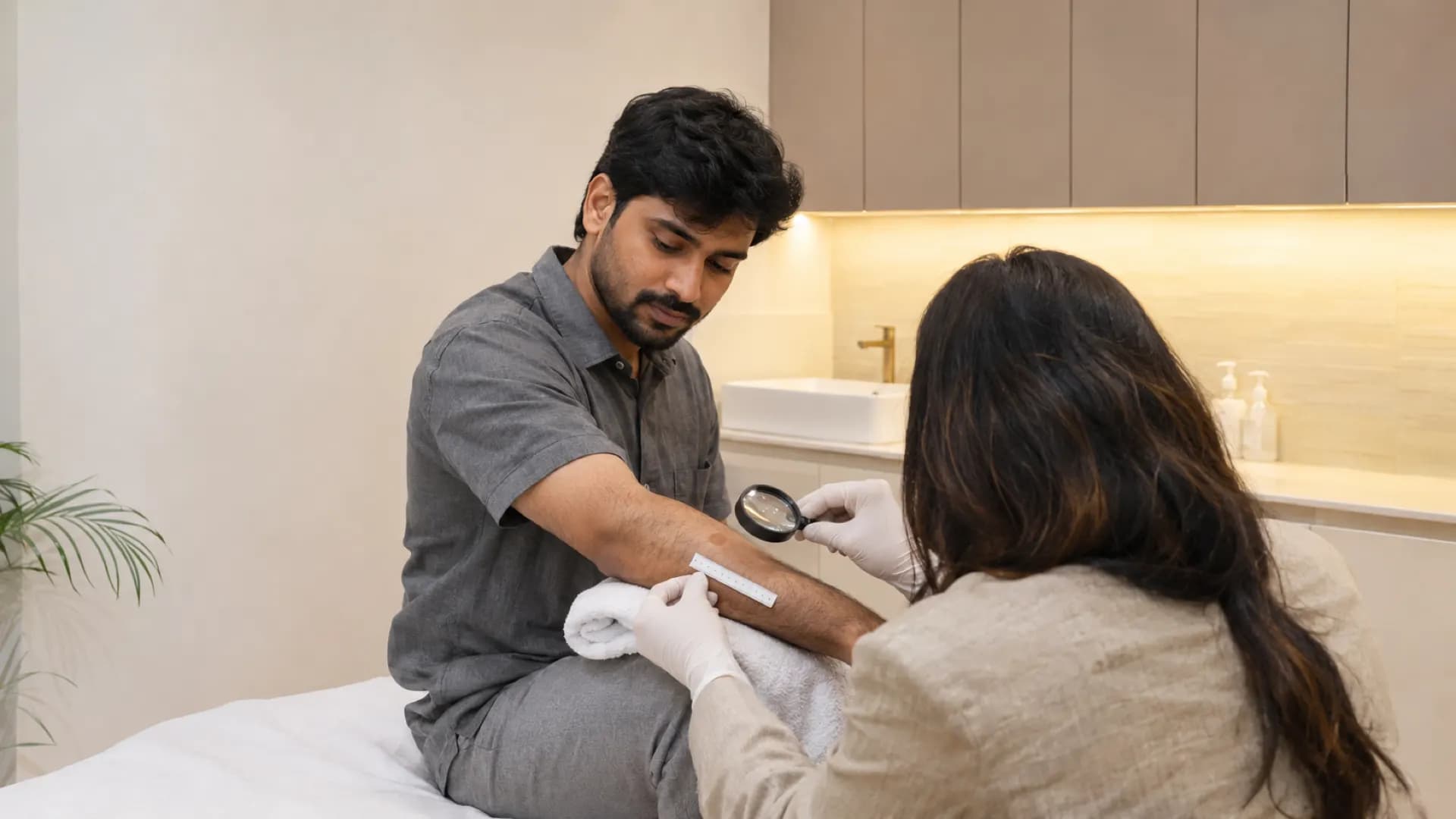
Your doctor looks at the mark in good light, often with a handheld magnifier, and asks when it appeared and whether it has changed. They name the birthmark and decide whether a medical review or a referral comes first.
Step 2
Medical review where needed
Moles, large or raised marks, several café-au-lait patches, marks near the eye and birthmarks in infants are reviewed first, and sometimes referred to a specialist. Treatment waits for that.
Step 3
Test spot and sessions
Where laser is suitable, a small area is treated first on brown skin. The course follows, spaced weeks apart, with the laser matched to what is in the skin.
Step 4
Care between sessions
Protect the area from the sun, keep the skin moisturised, and do not pick at crusts. Report blistering, spreading redness or darkening that is not fading.
Step 5
Review and watching for return
After the course your doctor reviews how much the mark has faded and tells you what to watch for. A top-up session may be advised if it returns, and any change in a mark should be checked.
What the research says
Published studies and guidelines, linked so you can read them yourself. Evidence is not a promise for any one person.
19 studies · 991 people. A pooled analysis of 19 studies with 991 people with café-au-lait patches found that 43.3% of patients reached at least 75% clearance and 75% reached at least 50% clearance. Recurrence was 13%, and dark or light patches after laser were each about 1.2%. Study quality was very low to moderate, and results varied widely between studies. (Laser treatment for café-au-lait macules: a systematic review and meta-analysis (PMC10249291), 2023) opens in a new tab
50 Indian patients · 6 sessions. In 50 Indian patients with naevus of Ota (skin types IV and V) treated with a Q-switched Nd:YAG laser, about 6 sessions over a year gave more than 60% improvement in 66% of patients and 30% to 60% in the rest. No significant adverse effects were seen over a year of follow-up, apart from transient dark patches. (QYAG5 Q-switched Nd:YAG laser treatment of nevus of Ota: an Indian study of 50 patients (PMC2840905), 2008) opens in a new tab
77 studies · recurrence common. A scoping review of 77 studies of lasers for benign pigmented lesions found Q-switched Nd:YAG lasers were used most often and worked well for naevus of Ota and other dermal pigment. Recurrence, dark patches and lighter patches were common, particularly in darker skin tones, and trials in diverse skin types are still needed. (Treatment of benign pigmented lesions using lasers: a scoping review (PMC12156075), 2025) opens in a new tab
6 more studies
24 studies · 434 patients. A systematic review of laser treatment for congenital melanocytic naevi found 24 studies with 434 patients, mostly of poor quality. Lasers cleared pigment in the short term, but scarring and return of colour were common, no malignant change was seen, and there was no high-quality evidence of long-term benefit. (Laser treatment of congenital melanocytic naevi: a systematic review, British Journal of Dermatology (PubMed 29077988), 2018) opens in a new tab
12 experts · pulsed dye laser. A consensus statement from 12 dermatology experts says the pulsed dye laser is the standard for port-wine birthmarks, that better outcomes may come from starting at an earlier age, and that laser can be safe at all ages in experienced hands. Whether a young child has general anaesthesia is a case-by-case decision. (Consensus statement for the management and treatment of port-wine birthmarks in Sturge-Weber syndrome, JAMA Dermatology (PMC8547264), 2021) opens in a new tab
0.3% to 0.5% of people. A review notes that port-wine stains affect 0.3% to 0.5% of people, usually darken with age if untreated and can become thick or nodular. Vascular lasers help by destroying the vessels, and early treatment produces better results. (Laser treatment of port-wine stains (PMC4296879), 2015) opens in a new tab
26 patients · sacral spots resist. In 26 Japanese patients with Mongolian spots treated with a Q-switched alexandrite laser, results were good overall and better when treatment began before age 20. Spots over the sacrum resisted laser more than spots elsewhere. (Laser treatment of 26 Japanese patients with Mongolian spots, Dermatologic Surgery (PubMed 19018824), 2008) opens in a new tab
25-year centre cohort. A review of congenital melanocytic naevi, with a 25-year centre cohort, says melanoma risk is greatest in childhood and relates to how severe the naevus is, and that it is why these marks are monitored by specialists. It is the reason a congenital mole is examined before any treatment. (Melanoma in congenital melanocytic naevi, British Journal of Dermatology (PMC5484991), 2017) opens in a new tab
6 or more patches · refer. DermNet NZ notes that 6 or more café-au-lait macules, larger than 5 mm in children or 15 mm in adults, is one of the main criteria for neurofibromatosis type 1, and that several patches should lead to a medical assessment and referral. A single patch is usually benign. (Café-au-lait macule, DermNet NZ, 2023) opens in a new tab
We will tell you if birthmark removal is not the right first step for you.
From examination to review
Typical milestones from published studies and guidelines. Your doctor sets your own schedule.
Before
Doctor names the birthmark; moles and changing marks come first
Test spot
A small area is treated first where laser is suitable
Each session
Redness or a crust for days; strict sun protection
Weeks to months apart
Next session, timed to the type of mark
After the course
Review the fade, watch for return, top up only if needed
What to expect
- Laser can fade some birthmarks. It rarely removes them completely, and some marks cannot be treated by laser.
- A course of several sessions is normal, and one session is not enough for most marks.
- A birthmark can return. In pooled data from café-au-lait lasers, about 13% did, with a wide range.
- Vascular, deep and raised marks differ from flat brown ones, so the number of sessions and the result differ too.
- Compare the cost of the whole course, not one session, and ask what happens if the mark returns.
Side effects and safety
- Redness, swelling and small crusts are common and usually settle in days. A cool compress helps.
- Indian skin (Fitzpatrick types III to V) is more prone to darker or lighter patches after lasers, so settings are chosen carefully. Most settle over months, and some can last. This is why a test spot and sun protection matter.
- Less often there are blisters, infection or scarring. Tell your doctor about keloid scars, cold sores and every medicine you use. Eye protection is worn for every session.
- A mole or mark that changes should be examined by a doctor. Treating a mole with a cosmetic laser can hide a change that needed to be seen.
- Salon and home devices are not supervised by a doctor. Contact the clinic promptly for blisters, spreading pain or darkening that does not fade.
Birthmark removal cost in Delhi
Your cost depends on the cause and the plan your doctor writes, which shows the full price before you begin.
What changes the cost
- The type of birthmark, which decides the laser used and how many sessions it needs.
- The size and site of the mark, because a small patch and a large area on the face or back are different plans.
- Any medical review, tests or referral your doctor advises before treatment.
- Whether you pay per session or for a package. Ask what a package includes and what happens if the mark returns.
Questions people ask
Can a birthmark be removed with laser?
Laser can fade some birthmarks, but it rarely removes them completely and cannot treat all of them. Flat brown café-au-lait patches, blue-grey Mongolian spots and naevus of Ota, and red port-wine stains respond to different lasers over several sessions. Moles, raised marks and large congenital naevi are examined first, and a laser may not suit them. A doctor names the birthmark before choosing any treatment.
Which birthmarks can laser not remove?
Laser reaches pigment or blood vessels near the surface, so deep, raised or thick marks respond poorly. Congenital moles can hold pigment cells deep in the skin, so a laser may lighten the surface while some stays. Large naevi, raised marks and marks with changing colour usually need examination, and sometimes surgery or watchful monitoring instead. Your doctor explains which applies to you.
How many sessions does birthmark laser removal take?
It depends on the type. A pooled analysis of café-au-lait lasers found at least 75% clearance in about 43% of patients, and one study used 1 to 9 sessions. Indian patients with naevus of Ota averaged 6 sessions over a year. Vascular marks usually need a longer course. Your doctor gives a range after examining the mark and reviews it as you go.
Will a birthmark come back after laser?
It can. In pooled data from 19 studies, about 13% of café-au-lait patches returned after laser, with a wide range between studies, and recurrence and uneven colour are described as common in darker skin. Deeper marks such as naevus of Ota may also need top-up sessions. Your doctor explains this before you start and reviews the area after the course.
How much does birthmark removal cost in Delhi?
This page shows no price range, because the cost depends on the type of birthmark, its size and site, the laser needed and the number of sessions. A small flat patch and a large area are very different plans. Your doctor confirms the plan and the full price in writing after examining the mark, before you begin. Compare the cost of the whole course, not one session.
Which birthmarks need a doctor to look at them first?
Several café-au-lait patches (six or more over 5 mm in a child, or 15 mm in an adult, is one criterion for neurofibromatosis type 1), any mole or birthmark that is changing, growing, bleeding or darkening, a large or raised congenital mole, a port-wine stain near the eye, and any raised red mark in an infant. These need a medical review before cosmetic treatment.
Can children have birthmark laser treatment?
Sometimes, and it is usually decided with a paediatric specialist. For port-wine stains, a consensus statement says earlier treatment tends to give better outcomes and that laser can be safe at any age in experienced hands, but anaesthesia in young children is decided case by case. In one study, Mongolian spots responded better when treated before age 20. Adults can usually be assessed and treated in clinic.
Is birthmark laser safe for Indian skin?
It can be, with the right laser and settings. Indian skin (types III to V) has more pigment, so temporary dark or light patches are more likely. In an Indian study of 50 patients with naevus of Ota, no significant adverse effects were seen beyond transient darkening. A pooled analysis found dark or light patches in about 1.2% each after café-au-lait lasers. A test spot and sun protection help.
Are freckles or sun spots birthmarks?
No. Freckles are small tan spots that darken with sun and fade in winter, and sun spots (lentigines) stay all year. Melasma is patchy darkening linked to sun and hormones. Birthmarks are present at birth or appear in early infancy. These are different conditions with different treatment, so see our pigmentation and melasma pages. Any spot that changes should be checked by a doctor.
What is the difference between a birthmark and a mole?
Some moles are birthmarks (congenital naevi), but most appear later in childhood or adult life. A mole is a cluster of pigment cells, and a doctor examines it before deciding whether to leave it, watch it or remove it. Laser has only weak evidence for congenital moles, and a mole that changes needs a medical check. Our mole and skin tag removal page explains how removal is decided.
Read next
Article
Dark Spots on Face: Causes, Types and What Helps
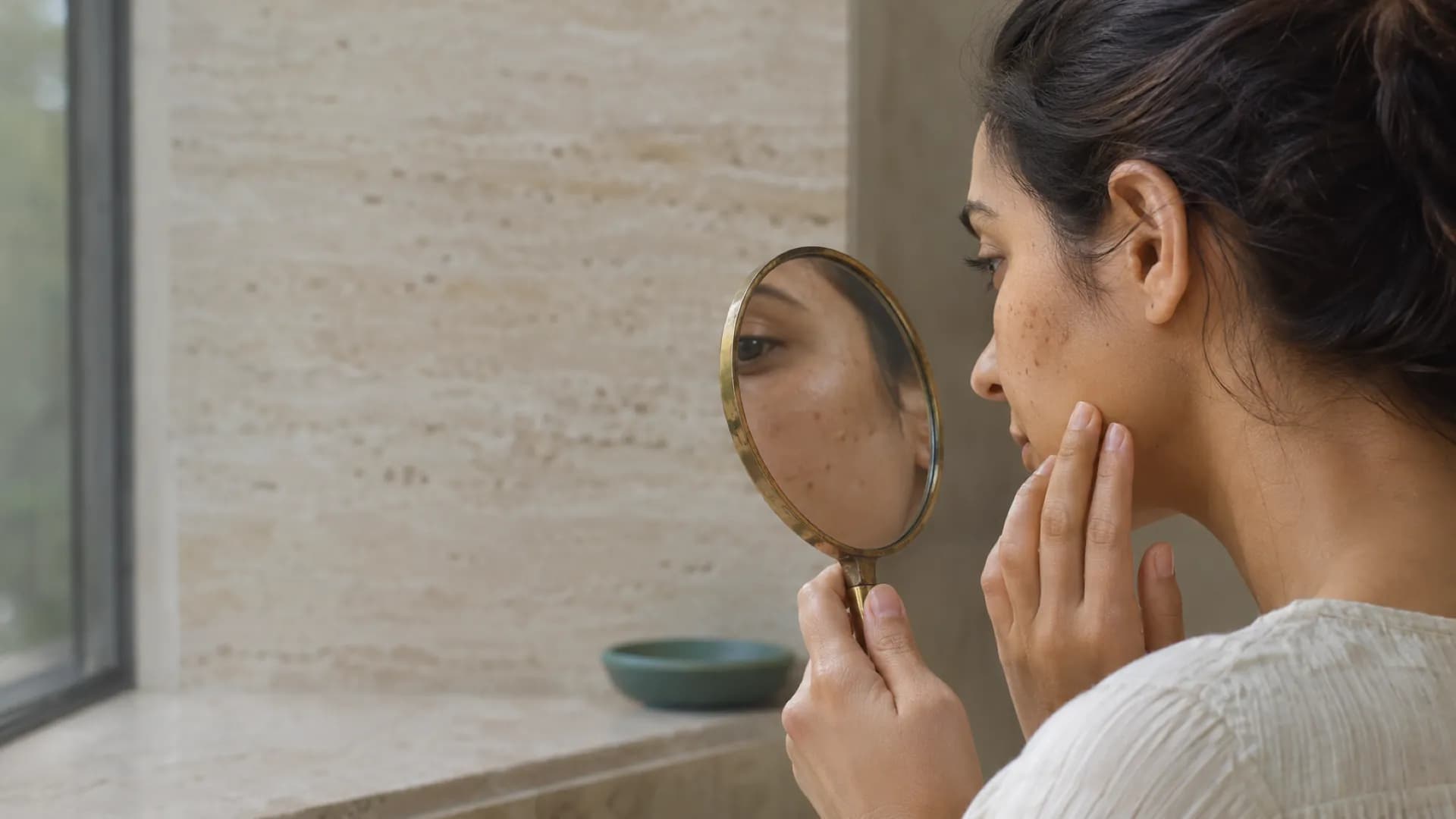
How to tell sun spots, marks left by acne and melasma apart, why depth in the skin matters, and what a doctor may suggest.
Article
Is Laser Lip Treatment Safe for Indian Skin?
Laser lip treatment is usually well tolerated in small studies, but cold sores, patchy colour and darkening on Indian skin are real risks. Who should wait.

Name the birthmark first, then choose the laser.
A doctor looks at your skin and what is behind the concern, then writes a plan with the full price before you begin.
Choose skin care, a centre and a time
Two taps. Nothing is stored on the website.
Your message opens in WhatsApp
You send it yourself and can add anything for the doctor.
The team confirms your visit
Your doctor reviews your history before suggesting anything.
4.9 from 1,238 Google reviews(Delhi centre)Doctor-led since 2004