
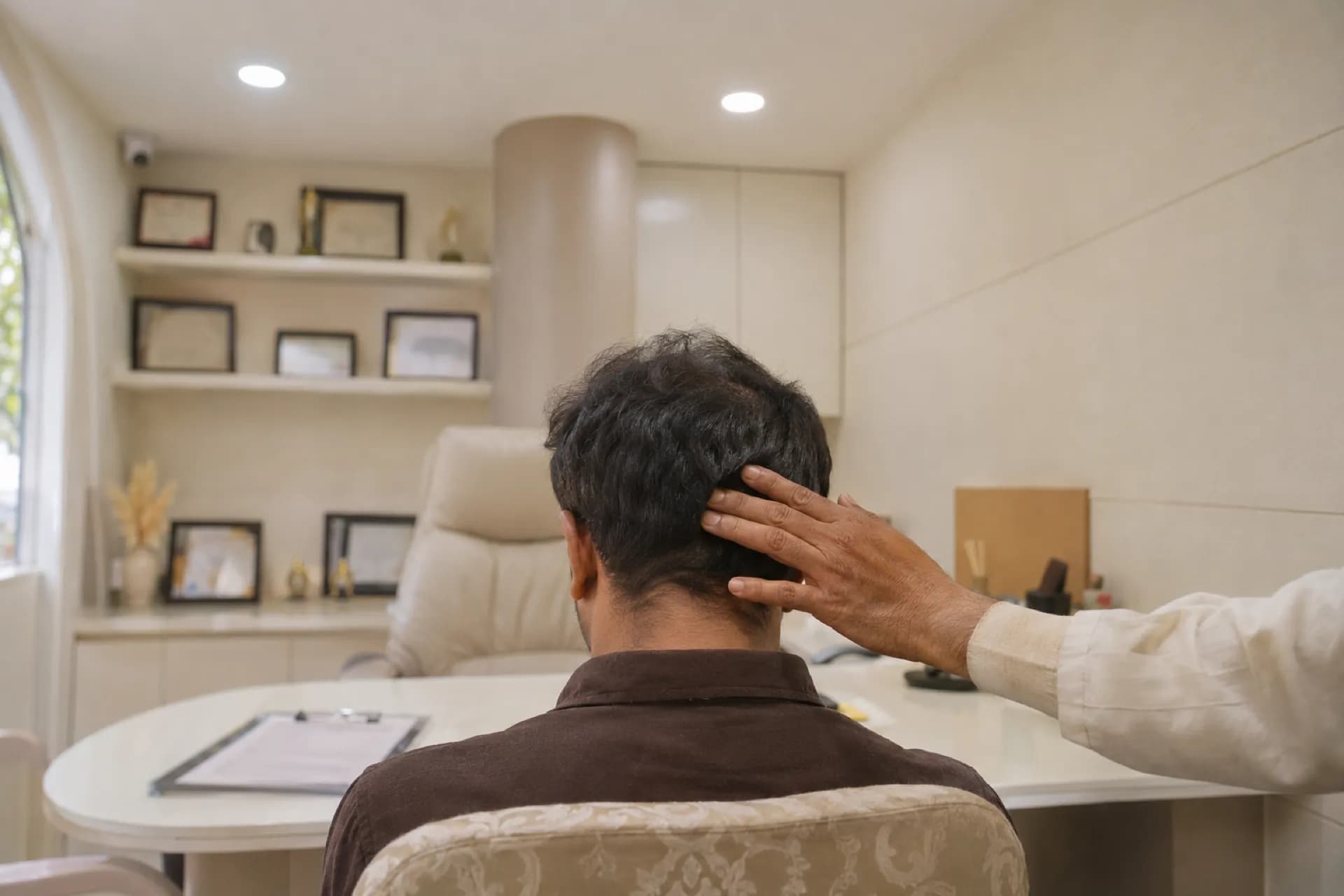
Scalp micropigmentation: a tattoo-like cover for thinning, not hair growth.
Tiny dots of pigment are placed in the scalp skin so it looks denser or freshly shaved. It does not grow hair, it can fade, and it is hard to undo, so the decision deserves time.
Two taps, then WhatsApp. A doctor reviews your history before any treatment is suggested.
4.9 from 1,238 Google reviews(Delhi centre)Doctor-led since 2004
Scalp Micropigmentation at a glance
- Indicative price
- ₹15,000–₹80,000 per course
- Sessions
- Several, plus a touch-up
- Effect
- Looks like hair, does not grow it
- Fading
- Can fade or change tone
- Removal
- Difficult, several laser sessions
- Works alongside
- Medical treatment, transplant
What these figures mean
- Indicative price
- Delhi NCR and India clinic pages. A hairline or crown costs less than the full scalp, and touch-ups may be extra.
- Sessions
- One 22-person series used 3 sessions and a touch-up about a month later. Your doctor sets the number.
- Effect
- Pigment sits in the skin between hairs. The follicles and the hair loss are unchanged.
- Fading
- In that series fading was minimal at about 20 months. Over the years touch-ups are common.
- Removal
- A small series cleared pigment in 1 to 3 picosecond laser sessions. It is not a quick undo.
- Works alongside
- It can sit beside treatments for the cause, or add density to a transplant. A doctor decides.
Indicative range in Delhi NCR. Your doctor confirms the plan and final price at consultation.Updated
The short answer
Scalp micropigmentation (SMP) deposits tiny dots of pigment in the scalp skin, in a tattoo-like way, so thinning hair looks denser or a shaved scalp looks like short stubble. It does not grow hair and does not treat the cause of hair loss. It suits diffuse thinning, scars and some alopecia, can fade and need touch-ups, and is difficult to remove if the result disappoints.
Is scalp micropigmentation right for your hair loss?
Often suits
- Men and women with diffuse thinning who want the scalp to show less through the hair, and who accept that the hair loss itself is not treated.
- Men with pattern hair loss who prefer, or are happy with, a closely shaved head and want it to look like short stubble.
- People with scars on the scalp, for example after a hair transplant, surgery or injury, who want to make the scar less visible.
- People with alopecia where hair is not expected to return, and people between transplants or wanting more visual density after one.
May not suit
- Anyone expecting hair to grow. SMP is pigment in the skin, not a hair treatment.
- Hair loss that is still progressing fast and whose cause has not been assessed. A doctor checks for treatable causes first.
- Anyone not sure about a long-lasting change to how the scalp looks, or who may want long hair on the scalp later.
3 more reasons
- Active scalp disease, infection or open skin, and anyone who has reacted to tattoo pigment before. A doctor reviews each.
- A tendency to keloid or raised scars. Tell your doctor before any skin puncture.
- Pregnancy or breastfeeding, when in-clinic cosmetic procedures are usually deferred and a doctor decides.
How scalp micropigmentation works, and what it leaves unchanged
SMP is medical-style tattooing of the scalp. A fine needle deposits tiny dots of pigment into the upper layers of the skin, in a stippling pattern between and around hairs. Under magnification the dots are grey to black, round and evenly spaced, and slightly larger than the real hair openings. From a normal distance the dots read as hair roots or as a closely cut head of hair. Because the pigment sits in the skin, nothing changes in the follicles and the hair loss carries on. What makes it look natural is the design of the hairline, the size and spacing of the dots and the shade, which is why a plain, even look suits it better than an exact, sharp hairline. Because pigment fades and shifts with time, and removal is difficult, getting the first design right matters more than the number of sessions.
Skin and a follicle with its hair. Where hair is thin, the scalp shows through.
Tiny pigment dots sit in the upper skin, so the scalp shows less. The follicle is unchanged.
- Changes: how the scalp looks from a normal distance.
- Does not change: the follicles, hair growth or the cause of the hair loss.
- Over time: pigment can fade or shift in tone, and removal is difficult.
General guidance; your doctor decides what suits you.
How care runs at Clinic Eximus
The same order for everyone, so nothing is decided before the cause is clear.
Step 1
Consultation
Your doctor looks at the cause and pattern of your hair loss, tells you what treatments for the cause exist, and checks your skin, scarring tendency and any past reaction to tattoo pigment.
Step 2
Design and shade
The hairline and area are drawn and agreed with you, and the pigment shade is chosen to match your hair or shaved scalp. A softer, natural line is usually preferred to a sharp one.
Step 3
Sessions
Pigment is placed over several sessions, building up density gradually. Skin response is checked between sessions so shade and dot size can be adjusted.
Step 4
Touch-up and aftercare
A touch-up is done after the main sessions. You are given instructions for the healing days, and told what to avoid while the skin settles.
Step 5
Long-term review
Pigment can fade or change tone over the years. Your doctor tells you when to come back for a touch-up and what removal would involve.
What the research says
Published studies and guidelines, linked so you can read them yourself. Evidence is not a promise for any one person.
Pigment dots, not hair. A clinical and pathology study describes SMP as concealing hair loss by depositing long-lasting pigment in a tattoo-like way, between hair follicles, in a stippling pattern that resembles closely cut hair. On magnification the dots are grey to black, round and evenly spaced, and larger than the nearby follicle openings. (Scalp micropigmentation: a clinicopathologic correlation, Skin Appendage Disorders (PubMed 36161085), 2022) opens in a new tab
22 people · 20 months. In 22 people (16 men, 6 women) with pattern hair loss, scalp scars or alopecia areata, treated with 3 sessions and a touch-up a month later and followed for 7 to 32 months (average 20), fading was minimal. One person had an allergic reaction, none had serious complications, and 80% of the group were very satisfied. It was a small series without a comparison group. (Scalp micropigmentation procedure: a useful procedure for hair restoration, Journal of Craniofacial Surgery (PubMed 33181616), 2021) opens in a new tab
43 people · 42 satisfied. In 43 Korean patients (23 women with female pattern hair loss, 14 men with male pattern hair loss and 6 with scalp scars), results were highly satisfactory in 42 and there were no adverse effects or complications. The one dissatisfied woman had early thinning and noticed little change. (Micropigmentation: camouflaging scalp alopecia and scars in Korean patients, Aesthetic Plastic Surgery (PubMed 24366233), 2014) opens in a new tab
4 more studies
120 corrections · 89% salon. Of 120 people seen for correction after an unsatisfactory SMP result, 107 (89%) had been treated at a tattoo or cosmetic facility in a beauty salon. Corrections included hair transplant (62%) and laser removal followed by redoing the SMP (13%). The authors say results of poorly done SMP are very hard to rectify and can cause severe distress. (Revision for unsatisfactory outcomes of scalp micropigmentation, International Journal of Dermatology (PubMed 38822591), 2025) opens in a new tab
4 people · 1 to 3 sessions. In 4 people with unwanted SMP, a 1064 nm picosecond laser cleared the pigment in 1 to 3 sessions with no unexpected adverse events. It is a small case series from a single group, and removal is still described as needed because of suboptimal outcomes. (Successful treatment of scalp micropigmentation with 1064 nm picosecond Nd:YAG laser, Lasers in Surgery and Medicine (PubMed 33289086), 2020) opens in a new tab
Camouflage, not treatment. A review calls SMP a widely used way of camouflaging scalp scars and alopecia and now considered a major option beside medicines and hair transplant. It stresses that natural results depend on technique and on correct information for patients. (Natural results of scalp micropigmentation: a review, Journal of Cosmetic Dermatology (PubMed 35947499), 2022) opens in a new tab
A cover-up, not medical. An early review describes SMP as a tattoo-based, non-medical cover-up that creates the illusion of thicker hair, and notes it is regulated as tattooing, not as a medical device. It addresses deformities that other treatments leave behind, for example after hair transplant. (Scalp micropigmentation: a concealer for hair and scalp deformities, Journal of Clinical and Aesthetic Dermatology (PubMed 25852813), 2015) opens in a new tab
We will tell you if scalp micropigmentation is not the right first step for you.
From design to touch-ups
Typical milestones from published studies and guidelines. Your doctor sets your own schedule.
Before
Cause of hair loss checked; hairline and shade agreed
Sessions
Pigment built up gradually over several visits
A month later
Touch-up after the main sessions
First days
Redness and tenderness settle; follow the aftercare advice
Over the years
Pigment may fade or change tone; touch-ups are common
What to expect
- SMP is a visual cover. It does not grow hair and does not stop hair loss, so any treatment for the cause continues.
- The look is short, even stubble or added density, not a full head of hair. It works well when the expectation is stubble or a shaved look.
- The pigment is long-lasting, but it can fade or change tone. In one series fading was minimal at about 20 months, and touch-ups are common over the years.
- Removal is difficult. Small series report clearing in 1 to 3 picosecond laser sessions, but a poor result can need correction, even a transplant.
- A salon-done result is a larger risk: in a review of 120 corrections, 89% had been done in a tattoo or cosmetic salon.
Side effects and safety
- Redness and tenderness settle within days. Follow the aftercare instructions.
- Allergic reaction to pigment was seen in 1 of 22 people in one series. Infection is possible with any skin puncture, so sterile technique matters.
- An uneven, unnatural or poorly matched result is the main risk. In a review of 120 corrections it was mostly after salon treatment.
- Pigment can fade or shift in tone with time, so a result that looked right can change.
- If you might want a hair transplant or other scalp treatment later, tell your doctor before SMP, since pigment affects planning.
- Indian skin can mark or scar more easily after skin puncture. Tell your doctor about keloid tendency and previous marks.
Scalp micropigmentation cost in Delhi
₹15,000–₹80,000
per course
Indicative range in Delhi NCR. Your doctor confirms the plan and final price at consultation.
What changes the cost
- The area: a hairline or crown costs less than the whole scalp.
- The number of sessions and whether the touch-up is included.
- Who does the treatment and where: a clinic with medical oversight costs more than a salon, but most corrections in one review came from salons.
- Future touch-ups, which are common over the years, and what removal would cost if you changed your mind.
Questions people ask
How much does scalp micropigmentation cost in Delhi?
Delhi NCR and Indian clinic pages commonly give about ₹15,000 to ₹80,000 for a course. That range is indicative, not a quote. A hairline or crown costs less than the whole scalp, and more sessions, a touch-up or a larger area add to the price. Clinic Eximus confirms the area, sessions and price in writing after your consultation.
Does scalp micropigmentation grow hair?
No. SMP places tiny dots of pigment in the scalp skin so thinning hair looks denser or a shaved head looks like short stubble. It does not change follicles or treat the cause of hair loss, so any treatment for the cause continues. If you want hair to grow, ask your doctor about medicines, PRP or GFC, or a transplant instead.
Is scalp micropigmentation permanent, and does it fade?
The pigment is long-lasting, but it can fade or change tone over the years. In a series of 22 people fading was minimal at about 20 months, and touch-ups are common over time. Because removal is difficult, treat it as a long-term change and plan the design to suit how your hair loss may progress.
Can scalp micropigmentation be removed?
With difficulty. A small series cleared pigment in 1 to 3 sessions of a picosecond laser, but removal is a separate treatment with its own cost, and a poor result can need correction or even a transplant. In a review of 120 corrections, most followed salon treatment. This is why the first design and the choice of clinic matter.
Who is scalp micropigmentation suitable for?
It suits diffuse thinning in men and women, a closely shaved look in pattern hair loss, scars on the scalp, alopecia where hair is not expected to return, and people between transplants or wanting more density after one. It does not suit expecting hair growth or fast-changing hair loss that has not been assessed. A doctor checks first.
Is scalp micropigmentation better than a hair transplant?
They do different things. A transplant moves living follicles so hair grows, at higher cost and with donor supply limits. SMP only changes how the scalp looks and does not grow hair. Some people have both: in one review, 25 of 120 people had both a transplant and SMP. Your doctor explains which suits your pattern, budget and goals.
What are the risks of scalp micropigmentation?
Redness and tenderness for a few days are expected. Risks include an allergic reaction to pigment, seen in 1 of 22 people in one series, infection, and an uneven or unnatural result. Pigment can fade or shift in tone. A poor result is hard to remove. Ask who does the treatment and how infection is prevented.
Does scalp micropigmentation work for women?
It can. Women with diffuse thinning or female pattern hair loss made up much of the published series, including 23 of 43 in a Korean study and 6 of 22 in another, and most were satisfied. The aim is to make the scalp show less through the hair. Because hair loss in women often has a treatable cause such as thyroid, iron or PCOS, that is checked first.
Read next
Article
How to Stop Hair Fall: Find the Cause, Then Treat It
What counts as normal shedding, how to tell shedding from pattern hair loss, the common causes, what helps at home, and when to see a doctor.

Article
PCOS Hair Loss: Why It Happens and What Helps
How PCOS can thin your hair, how that differs from ordinary shedding, which tests help, and the treatments a doctor may discuss with you.

Decide it slowly, because it is hard to undo.
A doctor checks why your hair is changing, then writes a plan with the full price before you begin.
Choose hair care, a centre and a time
Two taps. Nothing is stored on the website.
Your message opens in WhatsApp
You send it yourself and can add anything for the doctor.
The team confirms your visit
Your doctor reviews your history before suggesting anything.
4.9 from 1,238 Google reviews(Delhi centre)Doctor-led since 2004