
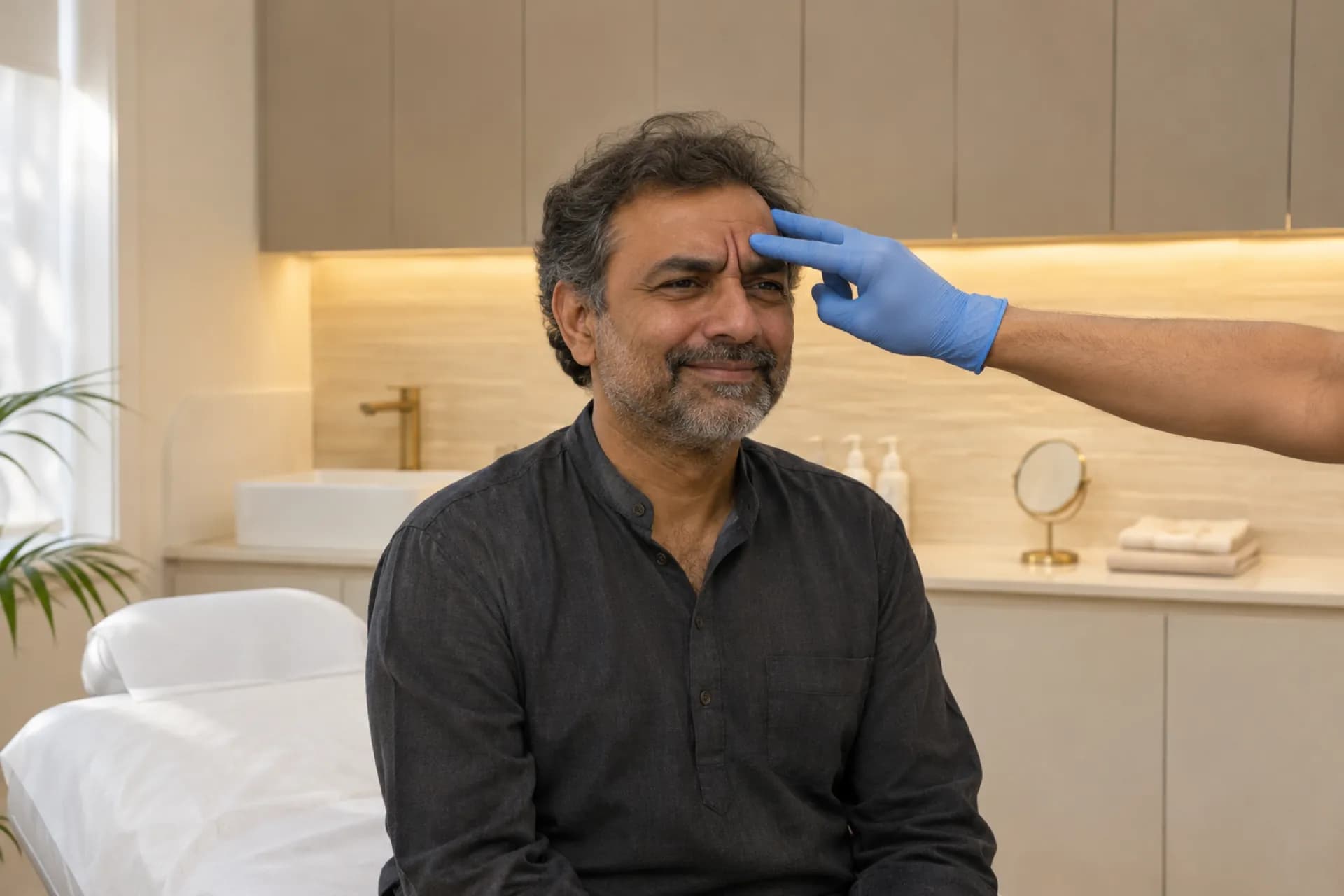
Botox treatment and the frozen look: placement and dose decide how naturally you move.
A doctor-led guide to botulinum toxin type A for forehead lines, frown lines and crow's feet: what it does, how long it lasts, the risks and the cost. It relaxes muscle. For lost volume, see dermal fillers.
Two taps, then WhatsApp. A doctor reviews your history before any treatment is suggested.
4.9 from 1,238 Google reviews(Delhi centre)Doctor-led since 2004
Botox (Anti-Wrinkle Injections) at a glance
- Indicative price
- ₹6,000–₹10,000 per area
- When it takes effect
- Gradually, over days
- How long it lasts
- About 4 months on average
- Downtime
- Little; small marks can appear
- Main risk to know
- Eyelid droop, about 2 to 3 in 100
- What it does not treat
- Lines from sun or lost volume
What these figures mean
- Indicative price
- Delhi NCR range. Forehead, frown lines and crow's feet count as separate areas; your doctor decides which suit you.
- When it takes effect
- It is not instant. Trials usually measure the result about a month after treatment.
- How long it lasts
- In pooled trials the median was 120 days for frown lines among people who responded (2012). It varies between people.
- Downtime
- Bruising and redness at the injection points are among the common effects. Your doctor explains what to avoid afterwards.
- Main risk to know
- Reported at about 2.5% of treatments. It usually starts within two weeks and passes over weeks as the effect wears off.
- What it does not treat
- It softens lines that movement creates. Lines at rest and hollows need other options, such as fillers or skin treatments.
Indicative range in Delhi NCR. Your doctor confirms the plan and final price at consultation.Updated
The short answer
Botox is the common name for botulinum toxin type A, a prescription medicine a doctor injects to relax the muscles that crease the skin, mainly frown lines, forehead lines and crow's feet. The effect builds over days and lasts about four months on average, so it is repeated if you want to keep it. A doctor decides whether it suits you, which areas to treat and how much, after seeing how your face moves.
Is Botox right for forehead lines, frown lines and crow's feet?
Often suits
- Lines between the brows, across the forehead or at the corners of the eyes that show when you frown, raise your brows or squint.
- Adults who want expression lines softened, not a face that cannot move.
- People who are comfortable with repeat visits every few months to keep the effect.
- People who have been told by a doctor that the lines come from muscle movement, not from sun damage or lost volume.
May not suit
- Pregnancy or breastfeeding. A doctor decides, and treatment is usually deferred.
- A nerve or muscle condition such as myasthenia gravis, or medicines that affect nerves and muscles. Tell your doctor first, because they may advise against it.
- Infection or an active skin problem where the injections would go, or a known allergy to an ingredient.
2 more reasons
- Naturally heavy upper eyelids or low brows. Weakening some muscles can add heaviness, so a doctor may advise leaving certain areas untreated.
- Anyone expecting deep lines at rest to disappear. Toxin softens movement, and deeper lines often need other treatment as well.
How Botox and anti-wrinkle injections work
Forehead lines, the vertical lines between the brows and the lines at the corners of the eyes form where a muscle pulls the skin the same way thousands of times a day. Botulinum toxin type A is a purified protein made by a bacterium. Injected in tiny amounts, it blocks the signal that tells a muscle to contract, so the muscle weakens and the skin above it creases less. As the nerve endings recover over a few months, the muscle returns to normal. That is why the effect is temporary and why it is repeated. It is a prescription medicine, so a doctor decides whether to use it, which product, which muscles and how much. Nothing on this page is a dose. What a doctor weighs is your face. They look at how strongly each muscle works, where your brows sit, whether your eyelids are heavy, whether one side differs from the other, and how you use your expressions. The muscles that pull the brows down and the ones that lift them work against each other, so treating one area changes the balance of the others. Botulinum toxin type A does not add volume, tighten loose skin or remove lines caused by sun. Those need other approaches, and this page does not cover them. Our dermal fillers page does.
How care runs at Clinic Eximus
The same order for everyone, so nothing is decided before the cause is clear.
Step 1
Consultation and history
Your doctor asks what bothers you and for your medical history: pregnancy or breastfeeding, nerve or muscle conditions, medicines, allergies and any earlier toxin treatment.
Step 2
Examination of how your face moves
Your face is examined at rest and as you frown, raise your brows and squint. The doctor judges muscle strength, brow position, eyelid weight and symmetry, and tells you plainly if toxin is not the right fit.
Step 3
A written plan with the price
If it suits you, the plan sets out the areas, the product, the price per area, what to expect and when you will be reviewed. You decide after reading it, with no pressure to start the same day.
Step 4
Treatment and aftercare
A doctor treats the agreed muscles with fine injections in a short visit. You receive written aftercare and the signs that need an urgent call, such as drooping or trouble swallowing or breathing.
Step 5
Review and repeat
The result is checked once the effect has settled, including balance and brow position. Repeat visits are planned only if you want to keep the effect.
What the research says
Published studies and guidelines, linked so you can read them yourself. Evidence is not a promise for any one person.
7 trials · 1,474 people. A meta-analysis of 7 randomised, placebo-controlled trials (1,474 people) found botulinum toxin type A improved frown lines far more often than placebo, including lines at rest, with no significant difference in how often side effects occurred. It covers frown lines only, and its trials ran up to 2014. (Guo et al., Botulinum toxin type A in glabellar lines: meta-analysis of randomised, placebo-controlled trials (PubMed 26313835), 2015) opens in a new tab
4 trials · 621 people. Pooling four phase III trials, the median duration of effect among people who responded at day 30 was 120 days for frown lines at full frown and 131 days at rest, so about four months. The trials tested one product in 621 treated people, and duration differs from person to person. (Glogau et al., Duration of effect in the treatment of glabellar lines: meta-analysis (PubMed 23106853), 2012) opens in a new tab
14 trials · 4,690 people. Across 14 placebo-controlled trials in 4,690 people treated for upper facial lines, side effects were reported by 42.1% on toxin and 35.8% on placebo, and serious events by 1.6% and 1.3%. Eyelid droop, brow droop, eyelid swelling and skin tightness were more frequent with toxin. Most were mild or moderate and settled within weeks. (Safety and tolerability in upper facial lines from global registration studies: meta-analysis (PMC10682279), 2023) opens in a new tab
3 more studies
24 trials · 4,268 sessions. In 24 randomised studies (4,268 injection sessions) to the forehead and frown area, 16% of toxin sessions were followed by a complication, against 12% of placebo sessions. Headache (6.3%) and bruising or local skin reactions (3.8%) were most common. Results varied widely between studies. (Complications of cosmetic botulinum toxin A injections to the upper face: systematic review and meta-analysis (PMC9005453), 2022) opens in a new tab
Eyelid droop about 2.5%. A review of toxin-related eyelid droop puts it at roughly 0.5% to 5% of treatments, about 2.5% on average. It usually starts 3 to 14 days after injection and lasts about 3 to 4 weeks, rarely months, and is reported more often with less experienced injectors. (Botulinum toxin-induced blepharoptosis: anatomy, aetiology, prevention and therapeutic options (PMC9290925), 2021) opens in a new tab
Brow droop about 3.1%. A global consensus of aesthetic experts advises treating to modulate muscle activity, not to paralyse it, and to use small amounts in few points. It reports brow droop of about 3.1% and says side effects relate more to dose and technique than to the product. (Global Aesthetics Consensus: botulinum toxin type A, evidence-based review and recommendations (PMC5242214), 2016) opens in a new tab
We will tell you if Botox is not the right first step for you.
From first visit to your next decision
Typical milestones from published studies and guidelines. Your doctor sets your own schedule.
Visit
Assessment, written plan and price, then treatment if it suits you
Days 1–14
The effect builds gradually; small marks at the injection points settle
Weeks 2–4
Review balance, brow position and any eyelid droop
Months 3–4
The effect fades gradually and the lines return to how they were
After that
Repeat only if you want to keep the effect, planned with your doctor
What to expect
- It softens lines made by movement. Lines at rest may improve, but deeper lines can remain.
- It is temporary. About four months is typical, and the effect fades gradually, so the lines return to how they were.
- It is gradual, not instant. Judge the result after it has settled, not on the first day.
- A natural look comes from restraint. The aim is a softer expression, not a frozen one, and a careful plan can look subtle.
- Keeping the effect means repeat treatment, so the cost is spread across the year, not paid once.
Side effects and safety
- Botulinum toxin type A is a prescription medicine. Ask who is prescribing and treating you, what product is used and where it comes from, and be wary of a price far below the usual range.
- Common effects are headache and bruising, redness or swelling at the injection points. In trials, headache followed about 6% of sessions and local skin reactions about 4%.
- Eyelid or brow droop happens in a small share of treatments, about 2.5% for the eyelid, usually from days 3 to 14, and it fades over weeks as the effect wears off. Tell your doctor if you notice it.
- Rarely, the toxin can spread beyond the treated area. Difficulty swallowing, speaking or breathing, or widespread weakness, needs urgent medical attention.
- Tell your doctor if you are pregnant, breastfeeding or planning a pregnancy. A doctor decides, and treatment is usually deferred.
Botox cost in Delhi: what you pay for
₹6,000–₹10,000
per area
Indicative range in Delhi NCR. Your doctor confirms the plan and final price at consultation.
What changes the cost
- How many areas are in your plan: forehead, frown lines and crow's feet are priced separately.
- Your doctor's assessment of how strong each muscle is, which shapes the plan.
- Whether a review visit is part of your plan.
- How often you repeat treatment over a year, if you choose to keep the effect.
Questions people ask
How much does Botox cost in Delhi?
Across Delhi NCR, Botox usually costs about ₹6,000 to ₹10,000 per area. Forehead lines, frown lines and crow's feet are separate areas, so your total depends on how many are in your plan. Your doctor confirms the plan and final price in writing at consultation. A price far below this range is worth questioning: ask what product is used and who prescribes it.
How long does Botox last?
About four months on average. In pooled trial data for frown lines, the median duration among people who responded was 120 days at full frown and 131 days at rest. It varies between people. The muscle recovers gradually, so lines return slowly, not overnight. Keeping the effect means repeat treatment, which your doctor will plan with you if you want it.
What are the side effects of Botox?
The common ones are headache and bruising, redness or swelling where the injections went. Eyelid droop occurs in roughly 2 to 3 in 100 treatments and brow droop in about 3 in 100, usually from days 3 to 14, and it fades over weeks. Difficulty swallowing, speaking or breathing is rare but needs urgent medical attention. A doctor explains the risks for your face first.
Is Botox safe, and who should avoid it?
In a 2023 analysis of 14 placebo-controlled trials in 4,690 people, serious events were similar on toxin and placebo (1.6% and 1.3%), and most side effects settled within weeks. It is still a prescription medicine, so a doctor decides. People who are pregnant or breastfeeding, or have a nerve or muscle condition, are usually advised to wait or avoid it.
Does Botox work on forehead lines, frown lines and crow's feet?
It works on lines created by muscle movement, and those three areas are the ones most often treated. Trials show clear improvement in frown lines, including at rest. Deep lines present at rest, or lines caused by sun damage or lost volume, may soften less and often need other treatment. A doctor examines how your face moves before deciding which areas are worth treating.
Should I get Botox or fillers?
They do different jobs. Botox relaxes the muscles that crease the skin, so it suits lines made by movement. Fillers add volume or shape where it has been lost, such as the lips, under-eyes, chin and jawline. Many people need only one, and some use both. A doctor examines your face and tells you which fits. Our dermal fillers page explains the other route.
Will Botox make my face look frozen?
Not if the plan is careful. Experts in a global consensus advise modulating muscle activity, not paralysing it, with small amounts in few points. Too much in the forehead or a poor balance of the brow muscles can leave a heavy or flat look, and brow droop occurred in about 3% of treatments. Say clearly how much movement you want to keep.
Is hair Botox the same as facial Botox?
No. Facial Botox is an injection of botulinum toxin type A by a doctor to relax muscles. Salon treatments sold as hair Botox are usually conditioning or smoothing treatments applied to the hair, not an injection into muscle. They share a name, not a method, so check what a treatment actually contains. This page covers the injection used for facial lines only.
Can botulinum toxin treat excessive sweating?
Botulinum toxin type A is an established option for severe underarm sweating (axillary hyperhidrosis) that has not responded to antiperspirants, and trials show a clear reduction in sweating for several months. Whether it suits you, and whether it is offered for sweating at our centres, is decided at consultation after the doctor rules out other causes, such as thyroid disease or medicines. Results wear off, so treatment is repeated.
Read next

Article
Hyperhidrosis: Causes, Treatment and What Helps
Primary and secondary excessive sweating, the causes a doctor checks first, and the options in order, from antiperspirants to botulinum toxin and surgery.

Article
Which Facial Suits Your Skin? A Guide by Skin Concern
Dry, oily, acne-prone, dull or sensitive: what each skin type needs from a facial, what to be careful with, and when to see a doctor first.
Article
Hydrafacial Benefits and Disadvantages: What the Evidence Shows
What a Hydrafacial can and cannot do, how strong the evidence is, the side effects to expect and who should be cautious or wait.

Ask for an assessment before you ask for a price.
A doctor looks at your skin and what is behind the concern, then writes a plan with the full price before you begin.
Choose skin care, a centre and a time
Two taps. Nothing is stored on the website.
Your message opens in WhatsApp
You send it yourself and can add anything for the doctor.
The team confirms your visit
Your doctor reviews your history before suggesting anything.
4.9 from 1,238 Google reviews(Delhi centre)Doctor-led since 2004